Class to handle multiple HTTP requests. More...
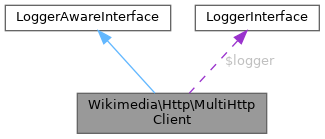
Inherits LoggerAwareInterface.
Public Member Functions | |
| __construct (array $options) | |
| Since 1.35, callers should use HttpRequestFactory::createMultiClient() to get a client object with appropriately configured timeouts instead of constructing a MultiHttpClient directly. | |
| __destruct () | |
| run (array $req, array $opts=[]) | |
| Execute an HTTP(S) request. | |
| runMulti (array $reqs, array $opts=[]) | |
| Execute a set of HTTP(S) requests. | |
| setLogger (LoggerInterface $logger) | |
| Register a logger. | |
Protected Member Functions | |
| getCurlHandle (array &$req, array $opts) | |
| getCurlMulti (array $opts) | |
| isCurlEnabled () | |
| Determines if the curl extension is available. | |
Protected Attributes | |
| string null | $caBundlePath |
| SSL certificates path. | |
| resource object null | $cmh = null |
| @phpcs:ignore MediaWiki.Commenting.PropertyDocumentation.ObjectTypeHintVar curl_multi_init() handle, initialized in getCurlMulti() | |
| float | $connTimeout = 10 |
| array array | $headers = [] |
| string false | $localProxy = false |
| string[] | $localVirtualHosts = [] |
| LoggerInterface | $logger |
| int | $maxConnsPerHost = 50 |
| float | $maxConnTimeout = INF |
| float | $maxReqTimeout = INF |
| string null | $proxy |
| proxy | |
| float | $reqTimeout = 30 |
| bool | $usePipelining = false |
| string | $userAgent = 'wikimedia/multi-http-client v1.1' |
Detailed Description
Class to handle multiple HTTP requests.
If curl is available, requests will be made concurrently. Otherwise, they will be made serially.
HTTP request maps are arrays that use the following format:
- method : GET/HEAD/PUT/POST/DELETE
- url : HTTP/HTTPS URL
- query : <query parameter field/value associative array> (uses RFC 3986)
- headers : <header name/value associative array>
- body : source to get the HTTP request body from; this can simply be a string (always), a resource for PUT requests, and a field/value array for POST request; array bodies are encoded as multipart/form-data and strings use application/x-www-form-urlencoded (headers sent automatically)
- stream : resource to stream the HTTP response body to
- proxy : HTTP proxy to use
- flags : map of boolean flags which supports:
- relayResponseHeaders : write out header via header() Request maps can use integer index 0 instead of 'method' and 1 instead of 'url'.
Since 1.35, callers should use HttpRequestFactory::createMultiClient() to get a client object with appropriately configured timeouts.
- Since
- 1.23
Definition at line 58 of file MultiHttpClient.php.
Constructor & Destructor Documentation
◆ __construct()
| Wikimedia\Http\MultiHttpClient::__construct | ( | array | $options | ) |
Since 1.35, callers should use HttpRequestFactory::createMultiClient() to get a client object with appropriately configured timeouts instead of constructing a MultiHttpClient directly.
- Parameters
-
array $options - connTimeout : default connection timeout (seconds)
- reqTimeout : default request timeout (seconds)
- maxConnTimeout : maximum connection timeout (seconds)
- maxReqTimeout : maximum request timeout (seconds)
- proxy : HTTP proxy to use
- localProxy : Reverse proxy to use for domains in localVirtualHosts
- localVirtualHosts : Domains that are configured as virtual hosts on the same machine
- usePipelining : whether to use HTTP pipelining if possible (for all hosts)
- maxConnsPerHost : maximum number of concurrent connections (per host)
- userAgent : The User-Agent header value to send
- logger : a \Psr\Log\LoggerInterface instance for debug logging
- caBundlePath : path to specific Certificate Authority bundle (if any)
- headers : an array of default headers to send with every request
- telemetry : a \Wikimedia\Http\RequestTelemetry instance to track telemetry data
- Exceptions
-
\Exception
Definition at line 122 of file MultiHttpClient.php.
◆ __destruct()
| Wikimedia\Http\MultiHttpClient::__destruct | ( | ) |
Definition at line 809 of file MultiHttpClient.php.
Member Function Documentation
◆ getCurlHandle()
|
protected |
- Parameters
-
array &$req HTTP request map @phpcs:ignore Generic.Files.LineLength array $opts - connTimeout : default connection timeout
- reqTimeout : default request timeout
- httpVersion: default HTTP version @phpcs:ignore MediaWiki.Commenting.FunctionComment.ObjectTypeHintReturn
- Returns
- resource|object
- Exceptions
-
\Exception
Definition at line 363 of file MultiHttpClient.php.
References $header, Wikimedia\Http\MultiHttpClient\$headers, $matches, $url, and Wikimedia\Http\MultiHttpClient\$userAgent.
◆ getCurlMulti()
|
protected |
- Parameters
-
array $opts @phpcs:ignore MediaWiki.Commenting.FunctionComment.ObjectTypeHintReturn
- Returns
- resource|object
- Exceptions
-
\Exception
Definition at line 496 of file MultiHttpClient.php.
References Wikimedia\Http\MultiHttpClient\$cmh, and Wikimedia\Http\MultiHttpClient\$maxConnsPerHost.
◆ isCurlEnabled()
|
protected |
Determines if the curl extension is available.
- Returns
- bool true if curl is available, false otherwise.
Definition at line 238 of file MultiHttpClient.php.
Referenced by Wikimedia\Http\MultiHttpClient\runMulti().
◆ run()
| Wikimedia\Http\MultiHttpClient::run | ( | array | $req, |
| array | $opts = [] ) |
Execute an HTTP(S) request.
This method returns a response map of:
- code : HTTP response code or 0 if there was a serious error
- reason : HTTP response reason (empty if there was a serious error)
- headers : <header name/value associative array>
- body : HTTP response body or resource (if "stream" was set)
- error : Any error string The map also stores integer-indexed copies of these values. This lets callers do: [ $rcode, $rdesc, $rhdrs, $rbody, $rerr ] = $http->run( $req );
- Parameters
-
array $req HTTP request array array $opts
- connTimeout : connection timeout per request (seconds)
- reqTimeout : post-connection timeout per request (seconds)
- usePipelining : whether to use HTTP pipelining if possible (for all hosts)
- maxConnsPerHost : maximum number of concurrent connections (per host)
- httpVersion : One of 'v1.0', 'v1.1', 'v2' or 'v2.0'. Leave empty to use PHP/curl's default
- Returns
- array Response array for request
Definition at line 165 of file MultiHttpClient.php.
References Wikimedia\Http\MultiHttpClient\runMulti().
◆ runMulti()
| Wikimedia\Http\MultiHttpClient::runMulti | ( | array | $reqs, |
| array | $opts = [] ) |
Execute a set of HTTP(S) requests.
If curl is available, requests will be made concurrently. Otherwise, they will be made serially.
The maps are returned by this method with the 'response' field set to a map of:
- code : HTTP response code or 0 if there was a serious error
- reason : HTTP response reason (empty if there was a serious error)
- headers : <header name/value associative array>
- body : HTTP response body or resource (if "stream" was set)
- error : Any error string The map also stores integer-indexed copies of these values. This lets callers do: All headers in the 'headers' field are normalized to use lower case names. This is true for the request headers and the response headers. Integer-indexed method/URL entries will also be changed to use the corresponding string keys.[ $rcode, $rdesc, $rhdrs, $rbody, $rerr ] = $req['response'];
- Parameters
-
array[] $reqs Map of HTTP request arrays array $opts Options - connTimeout : connection timeout per request (seconds)
- reqTimeout : post-connection timeout per request (seconds)
- usePipelining : whether to use HTTP pipelining if possible (for all hosts)
- maxConnsPerHost : maximum number of concurrent connections (per host)
- httpVersion : One of 'v1.0', 'v1.1', 'v2' or 'v2.0'. Leave empty to use PHP/curl's default
- Returns
- array[] $reqs With response array populated for each
- Exceptions
-
\Exception
Definition at line 200 of file MultiHttpClient.php.
References Wikimedia\Http\MultiHttpClient\$connTimeout, Wikimedia\Http\MultiHttpClient\$maxConnTimeout, Wikimedia\Http\MultiHttpClient\$maxReqTimeout, Wikimedia\Http\MultiHttpClient\$reqTimeout, and Wikimedia\Http\MultiHttpClient\isCurlEnabled().
Referenced by Wikimedia\Http\MultiHttpClient\run().
◆ setLogger()
| Wikimedia\Http\MultiHttpClient::setLogger | ( | LoggerInterface | $logger | ) |
Register a logger.
- Parameters
-
LoggerInterface $logger
Definition at line 805 of file MultiHttpClient.php.
Member Data Documentation
◆ $caBundlePath
|
protected |
SSL certificates path.
Definition at line 67 of file MultiHttpClient.php.
◆ $cmh
|
protected |
@phpcs:ignore MediaWiki.Commenting.PropertyDocumentation.ObjectTypeHintVar curl_multi_init() handle, initialized in getCurlMulti()
Definition at line 65 of file MultiHttpClient.php.
Referenced by Wikimedia\Http\MultiHttpClient\getCurlMulti().
◆ $connTimeout
|
protected |
Definition at line 69 of file MultiHttpClient.php.
Referenced by Wikimedia\Http\MultiHttpClient\runMulti().
◆ $headers
|
protected |
Definition at line 91 of file MultiHttpClient.php.
Referenced by Wikimedia\Http\MultiHttpClient\getCurlHandle().
◆ $localProxy
|
protected |
Definition at line 83 of file MultiHttpClient.php.
◆ $localVirtualHosts
|
protected |
Definition at line 85 of file MultiHttpClient.php.
◆ $logger
|
protected |
Definition at line 89 of file MultiHttpClient.php.
◆ $maxConnsPerHost
|
protected |
Definition at line 79 of file MultiHttpClient.php.
Referenced by Wikimedia\Http\MultiHttpClient\getCurlMulti().
◆ $maxConnTimeout
|
protected |
Definition at line 71 of file MultiHttpClient.php.
Referenced by Wikimedia\Http\MultiHttpClient\runMulti().
◆ $maxReqTimeout
|
protected |
Definition at line 75 of file MultiHttpClient.php.
Referenced by Wikimedia\Http\MultiHttpClient\runMulti().
◆ $proxy
|
protected |
proxy
Definition at line 81 of file MultiHttpClient.php.
◆ $reqTimeout
|
protected |
Definition at line 73 of file MultiHttpClient.php.
Referenced by Wikimedia\Http\MultiHttpClient\runMulti().
◆ $usePipelining
|
protected |
Definition at line 77 of file MultiHttpClient.php.
◆ $userAgent
|
protected |
Definition at line 87 of file MultiHttpClient.php.
Referenced by Wikimedia\Http\MultiHttpClient\getCurlHandle().
The documentation for this class was generated from the following file:
- includes/libs/http/MultiHttpClient.php