LoadBalancer manager for sites with several "main" database clusters. More...
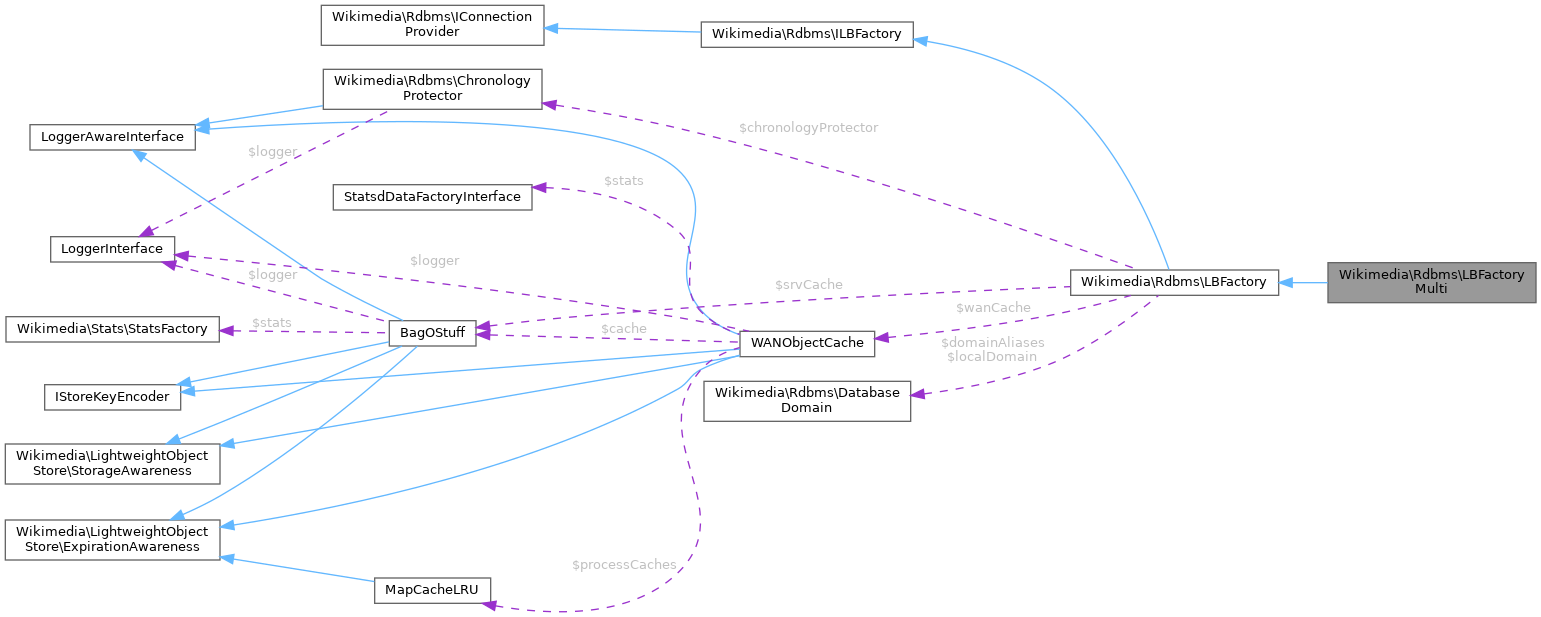
Inherits Wikimedia\Rdbms\LBFactory.
Public Member Functions | |
| __construct (array $conf) | |
| Template override precedence (highest => lowest): | |
| getAllExternalLBs () | |
| Get the tracked load balancer instances for all external clusters. | |
| getAllMainLBs () | |
| Get the tracked load balancer instances for all main clusters. | |
| getExternalLB ( $cluster) | |
| Get the tracked load balancer instance for an external cluster. | |
| getMainLB ( $domain=false) | |
| Get the tracked load balancer instance for the main cluster that handles the given domain. | |
| newExternalLB ( $cluster) | |
| Create a new load balancer instance for an external cluster. | |
| newMainLB ( $domain=false) | |
| Create a new load balancer instance for the main cluster that handles the given domain. | |
| reconfigure (array $conf) | |
| Reconfigure using the given config array. | |
 Public Member Functions inherited from Wikimedia\Rdbms\LBFactory Public Member Functions inherited from Wikimedia\Rdbms\LBFactory | |
| autoReconfigure () | |
| Reload config using the callback passed defined $config['configCallback']. | |
| beginPrimaryChanges ( $fname=__METHOD__) | |
| Flush any primary transaction snapshots and set DBO_TRX (if DBO_DEFAULT is set) | |
| closeAll ( $fname=__METHOD__) | |
| Close all connections on instantiated tracked load balancer instances. | |
| commitAndWaitForReplication ( $fname, $ticket, array $opts=[]) | |
| Commit primary DB transactions and wait for replication (if $ticket indicates it is safe). | |
| commitPrimaryChanges ( $fname=__METHOD__, int $maxWriteDuration=0) | |
| Commit changes and clear view snapshots on all primary connections. | |
| destroy () | |
| Close all connections and make further attempts to open connections result in DBAccessError. | |
| disableChronologyProtection () | |
| Disable the ChronologyProtector on all instantiated tracked load balancer instances. | |
| flushPrimarySessions ( $fname=__METHOD__) | |
| Release important session-level state (named lock, table locks) as post-rollback cleanup. | |
| flushReplicaSnapshots ( $fname=__METHOD__) | |
| Commit all replica database server transactions, clearing any REPEATABLE-READ/SSI snapshots. | |
| getAllLBs () | |
| Get all tracked load balancer instances (generator) | |
| getEmptyTransactionTicket ( $fname) | |
| Get a token asserting that no write transactions are active on tracked connections. | |
| getLoadBalancer ( $domain=false) | |
| Get the tracked load balancer instance for a given domain. | |
| getLocalDomainID () | |
| Get the local (and default) database domain ID of connection handles. | |
| getPrimaryDatabase ( $domain=false) | |
| Get connection to the primary database. | |
| getReplicaDatabase ( $domain=false, $group=null) | |
| Get connection to a replica database. | |
| getTransactionProfiler () | |
| Get the TransactionProfiler used by this instance. | |
| hasOrMadeRecentPrimaryChanges ( $age=null) | |
| Determine if any primary connection has pending/written changes from this request. | |
| hasPrimaryChanges () | |
| Determine if any primary connection has pending changes. | |
| hasStreamingReplicaServers () | |
| Whether it has streaming replica servers. | |
| hasTransactionRound () | |
| Check if an explicit transaction round is active. | |
| isReadyForRoundOperations () | |
| Check if transaction rounds can be started, committed, or rolled back right now. | |
| laggedReplicaUsed () | |
| Determine if any lagged replica database server connection was used. | |
| redefineLocalDomain ( $domain) | |
| Close all connections and redefine the local database domain. | |
| rollbackPrimaryChanges ( $fname=__METHOD__) | |
| Rollback changes on all primary connections. | |
| setAgentName ( $agent) | |
| setDefaultReplicationWaitTimeout ( $seconds) | |
| Set the default timeout for replication wait checks. | |
| setDomainAliases (array $aliases) | |
| Convert certain database domains to alternative ones. | |
| setIndexAliases (array $aliases) | |
| Convert certain index names to alternative names before querying the DB. | |
| setLocalDomainPrefix ( $prefix) | |
| Set a new table prefix for the existing local domain ID for testing. | |
| setTableAliases (array $aliases) | |
| Make certain table names use their own database, schema, and table prefix when passed into SQL queries pre-escaped and without a qualified database name. | |
| setWaitForReplicationListener ( $name, callable $callback=null) | |
| Add a callback to be run in every call to waitForReplication() before waiting. | |
| shutdown ( $flags=self::SHUTDOWN_NORMAL, callable $workCallback=null, &$cpIndex=null, &$cpClientId=null) | |
| Prepare all instantiated tracked load balancer instances for shutdown. | |
| waitForReplication (array $opts=[]) | |
| Waits for the replica database server to catch up to the current primary position. | |
Protected Member Functions | |
| getLBsForOwner () | |
| Get all tracked load balancers with the internal "for owner" interface. | |
| Protected Member Functions inherited from Wikimedia\Rdbms\LBFactory | |
| baseLoadBalancerParams () | |
| Get parameters to ILoadBalancer::__construct() | |
| configure (array $conf) | |
| initLoadBalancer (ILoadBalancerForOwner $lb) | |
Additional Inherited Members | |
| Public Attributes inherited from Wikimedia\Rdbms\ILBFactory | |
| const | SHUTDOWN_NO_CHRONPROT = 1 |
| Do not save "session consistency" DB replication positions. | |
| const | SHUTDOWN_NORMAL = 0 |
| Idiom for "no special shutdown flags". | |
| Protected Attributes inherited from Wikimedia\Rdbms\LBFactory | |
| ChronologyProtector | $chronologyProtector |
| DatabaseDomain[] string[] | $domainAliases = [] |
| Map of (domain alias => DB domain) | |
| DatabaseDomain | $localDomain |
| Local domain. | |
| string false | $readOnlyReason = false |
| Reason all LBs are read-only or false if not. | |
| BagOStuff | $srvCache |
| array string[] | $virtualDomains = [] |
| List of registered virtual domains. | |
| array array[] | $virtualDomainsMapping = [] |
| Map of virtual domain to array of cluster and domain. | |
| WANObjectCache | $wanCache |
Detailed Description
LoadBalancer manager for sites with several "main" database clusters.
Each database cluster consists of a "primary" server and any number of replica servers, all of which converge, as soon as possible, to contain the same schemas and records. If a replication topology has multiple primaries, then the "primary" is merely the preferred co-primary for the current context (e.g. datacenter).
For single-primary topologies, the schemas and records of the primary define the "dataset". For multiple-primary topologies, the "dataset" is the convergent result of applying/merging all committed events (regardless of the co-primary they originated on); it possible that no co-primary has yet converged upon this state at any given time (especially when there are frequent writes and co-primaries are geographically distant).
A "main" cluster contain a "main" dataset, which consists of data that is compact, highly relational (e.g. read by JOIN queries), and essential to one or more sites. The "external" clusters each store an "external" dataset, which consists of data that is non-relational (e.g. key/value pairs), self-contained (e.g. JOIN queries and transactions thereof never involve a main dataset), or too bulky to reside in a main dataset (e.g. text blobs).
The class allows for large site farms to split up their data in the following ways:
- Vertically shard compact site-specific data by site (e.g. page/comment metadata)
- Vertically shard compact global data by module (e.g. account/notification data)
- Horizontally shard any bulk data by blob key (e.g. page/comment content blobs)
Definition at line 53 of file LBFactoryMulti.php.
Constructor & Destructor Documentation
◆ __construct()
| Wikimedia\Rdbms\LBFactoryMulti::__construct | ( | array | $conf | ) |
Template override precedence (highest => lowest):
- templateOverridesByServer
- masterTemplateOverrides
- templateOverridesBySection/templateOverridesByCluster
- externalTemplateOverrides
- serverTemplate Overrides only work on top level keys (so nested values will not be merged).
Server config maps should be of the format Database::factory() requires. Additionally, a 'max lag' key should also be set on server maps, indicating how stale the data can be before the load balancer tries to avoid using it. The map can have 'is static' set to disable blocking replication sync checks (intended for archive servers with unchanging data).
- See also
- LBFactory::__construct()
- Parameters
-
array $conf Additional parameters include: - hostsByName: map of (server name => IP address). [optional]
- sectionsByDB: map of (database => main section). The database name "DEFAULT" is interpreted as a catch-all for all databases not otherwise mentioned. If no section name is specified for "DEFAULT", then the catch-all section is assumed to be named "DEFAULT". [optional]
- sectionLoads: map of (main section => server name => load ratio); the first host listed in each section is the primary DB server for that section. [optional]
- groupLoadsBySection: map of (main section => group => server name => group load ratio). Any ILoadBalancer::GROUP_GENERIC group will be ignored. [optional]
- externalLoads: map of (cluster => server name => load ratio) map. [optional]
- serverTemplate: server config map for Database::factory(). Note that "host", "serverName" and "load" entries will be overridden by "groupLoadsBySection" and "hostsByName". [optional]
- externalTemplateOverrides: server config map overrides for external stores; respects the override precedence described above. [optional]
- templateOverridesBySection: map of (main section => server config map overrides); respects the override precedence described above. [optional]
- templateOverridesByCluster: map of (external cluster => server config map overrides); respects the override precedence described above. [optional]
- masterTemplateOverrides: server config map overrides for masters; respects the override precedence described above. [optional]
- templateOverridesByServer: map of (server name => server config map overrides); respects the override precedence described above and applies to both core and external storage. [optional]
- loadMonitor: LoadMonitor::__construct() parameters with "class" field. [optional]
- readOnlyBySection: map of (main section => message text or false). String values make sections read only, whereas anything else does not restrict read/write mode. [optional]
- configCallback: A callback that returns a conf array that can be passed to the reconfigure() method. This will be used to autoReconfigure() to load any updated configuration.
Reimplemented from Wikimedia\Rdbms\LBFactory.
Definition at line 135 of file LBFactoryMulti.php.
References Wikimedia\Rdbms\ILoadBalancer\GROUP_GENERIC.
Member Function Documentation
◆ getAllExternalLBs()
| Wikimedia\Rdbms\LBFactoryMulti::getAllExternalLBs | ( | ) |
Get the tracked load balancer instances for all external clusters.
If no tracked instance exists for a cluster, then one will be instantiated
- Returns
- ILoadBalancer[] Map of (cluster name => ILoadBalancer)
- Since
- 1.29
Implements Wikimedia\Rdbms\ILBFactory.
Definition at line 269 of file LBFactoryMulti.php.
◆ getAllMainLBs()
| Wikimedia\Rdbms\LBFactoryMulti::getAllMainLBs | ( | ) |
Get the tracked load balancer instances for all main clusters.
If no tracked instance exists for a cluster, then one will be instantiated
Note that default main cluster name is ILoadBalancer::CLUSTER_MAIN_DEFAULT
- Returns
- ILoadBalancer[] Map of (cluster name => ILoadBalancer)
- Since
- 1.29
Implements Wikimedia\Rdbms\ILBFactory.
Definition at line 258 of file LBFactoryMulti.php.
◆ getExternalLB()
| Wikimedia\Rdbms\LBFactoryMulti::getExternalLB | ( | $cluster | ) |
Get the tracked load balancer instance for an external cluster.
If no tracked instances exists, then one will be instantiated
- Parameters
-
string $cluster External cluster name
- Exceptions
-
InvalidArgumentException If $cluster is not recognized
- Returns
- ILoadBalancer
Implements Wikimedia\Rdbms\ILBFactory.
Definition at line 248 of file LBFactoryMulti.php.
◆ getLBsForOwner()
|
protected |
Get all tracked load balancers with the internal "for owner" interface.
Most subclasses override this, we just provide an implementation here for the benefit of Wikibase's FakeLBFactory.
- Returns
- Generator|ILoadBalancerForOwner[]
Reimplemented from Wikimedia\Rdbms\LBFactory.
Definition at line 278 of file LBFactoryMulti.php.
◆ getMainLB()
| Wikimedia\Rdbms\LBFactoryMulti::getMainLB | ( | $domain = false | ) |
Get the tracked load balancer instance for the main cluster that handles the given domain.
If no tracked instances exists, then one will be instantiated
- Note
- The local/default database domain used by the load balancer instance will still inherit from this ILBFactory instance, regardless of the $domain parameter.
- Parameters
-
string | false $domain Domain ID, or false for the current domain
- Returns
- ILoadBalancer
Implements Wikimedia\Rdbms\ILBFactory.
Definition at line 221 of file LBFactoryMulti.php.
◆ newExternalLB()
| Wikimedia\Rdbms\LBFactoryMulti::newExternalLB | ( | $cluster | ) |
Create a new load balancer instance for an external cluster.
The resulting object will be untracked and the caller is responsible for cleaning it up. Database replication positions will not be saved by ChronologyProtector.
This method is for only advanced usage and callers should almost always use getExternalLB() instead. This method can be useful when a table is used as a key/value store. In that cases, one might want to query it in autocommit mode (DBO_TRX off) but still use DBO_TRX transaction rounds on other tables.
- Parameters
-
string $cluster External cluster name
- Exceptions
-
InvalidArgumentException If $cluster is not recognized
- Returns
- ILoadBalancerForOwner
Implements Wikimedia\Rdbms\ILBFactory.
Definition at line 232 of file LBFactoryMulti.php.
◆ newMainLB()
| Wikimedia\Rdbms\LBFactoryMulti::newMainLB | ( | $domain = false | ) |
Create a new load balancer instance for the main cluster that handles the given domain.
The resulting object will be untracked and the caller is responsible for cleaning it up. Database replication positions will not be saved by ChronologyProtector.
This method is for only advanced usage and callers should almost always use getMainLB() instead. This method can be useful when a table is used as a key/value store. In that cases, one might want to query it in autocommit mode (DBO_TRX off) but still use DBO_TRX transaction rounds on other tables.
- Note
- The local/default database domain used by the load balancer instance will still inherit from this ILBFactory instance, regardless of the $domain parameter.
- Parameters
-
string | false $domain Domain ID, or false for the current domain
- Returns
- ILoadBalancerForOwner
Implements Wikimedia\Rdbms\ILBFactory.
Definition at line 171 of file LBFactoryMulti.php.
◆ reconfigure()
| Wikimedia\Rdbms\LBFactoryMulti::reconfigure | ( | array | $conf | ) |
Reconfigure using the given config array.
Any fields omitted from $conf will be taken from the current config.
If the config changed, this calls reconfigure() on all load balancers, which causes them to close all existing connections.
- Note
- This invalidates the current transaction ticket.
- Warning
- This must only be called in top level code such as the execute() method of a maintenance script. Any database connection in use when this method is called will become defunct.
- Since
- 1.39
- Parameters
-
array $conf A configuration array, using the same structure as the one passed to the constructor (see also $wgLBFactoryConf).
Reimplemented from Wikimedia\Rdbms\LBFactory.
Definition at line 367 of file LBFactoryMulti.php.
The documentation for this class was generated from the following file:
- includes/libs/rdbms/lbfactory/LBFactoryMulti.php