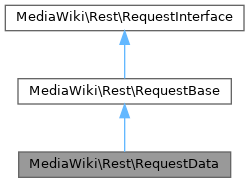
This is a Request class that allows data to be injected, for the purposes of testing or internal requests. More...
Inherits MediaWiki\Rest\RequestBase.
Public Member Functions | |
| __construct ( $params=[]) | |
| Construct a RequestData from an array of parameters. | |
| getBody () | |
| Gets the body of the message. | |
| getCookieParams () | |
| Retrieve cookies. | |
| getMethod () | |
| Retrieves the HTTP method of the request. | |
| getPostParams () | |
| Retrieve POST form parameters. | |
| getProtocolVersion () | |
| Retrieves the HTTP protocol version as a string. | |
| getQueryParams () | |
| Retrieve query string arguments. | |
| getServerParams () | |
| Retrieve server parameters. | |
| getUploadedFiles () | |
| Retrieve normalized file upload data. | |
| getUri () | |
| Retrieves the URI instance. | |
| hasBody () | |
| Return true if the client provided a content-length header or a transfer-encoding header. | |
 Public Member Functions inherited from MediaWiki\Rest\RequestBase Public Member Functions inherited from MediaWiki\Rest\RequestBase | |
| __clone () | |
| getBodyType () | |
| Returns the MIME type of the request body, according to the content-type header. | |
| getCookie ( $name, $default=null) | |
| Add the cookie prefix to a specified cookie name and get the value of the resulting prefixed cookie. | |
| getCookiePrefix () | |
| Get the current cookie prefix. | |
| getHeader ( $name) | |
| Retrieves a message header value by the given case-insensitive name. | |
| getHeaderLine ( $name) | |
| Retrieves a comma-separated string of the values for a single header. | |
| getHeaders () | |
| Retrieves all message header values. | |
| getParsedBody () | |
| Returns the parsed body as an associative array. | |
| getPathParam ( $name) | |
| Retrieve a single path parameter. | |
| getPathParams () | |
| Get the parameters derived from the path template match. | |
| hasHeader ( $name) | |
| Checks if a header exists by the given case-insensitive name. | |
| setHeaders ( $headers) | |
| Erase any existing headers and replace them with the specified header lines. | |
| setParsedBody (?array $data) | |
| Specify the data that subsequent calls to getParsedBody() should return. | |
| setPathParams ( $params) | |
| Erase all path parameters from the object and set the parameter array to the one specified. | |
Additional Inherited Members | |
| Public Attributes inherited from MediaWiki\Rest\RequestInterface | |
| const | FORM_URLENCODED_CONTENT_TYPE = 'application/x-www-form-urlencoded' |
| const | JSON_CONTENT_TYPE = 'application/json' |
| const | MULTIPART_FORM_DATA_CONTENT_TYPE = 'multipart/form-data' |
| Protected Member Functions inherited from MediaWiki\Rest\RequestBase | |
| initHeaders () | |
| Override this in the implementation class if lazy initialisation of header values is desired. | |
| Protected Attributes inherited from MediaWiki\Rest\RequestBase | |
| array | $parsedBody = null |
Detailed Description
This is a Request class that allows data to be injected, for the purposes of testing or internal requests.
Definition at line 14 of file RequestData.php.
Constructor & Destructor Documentation
◆ __construct()
| MediaWiki\Rest\RequestData::__construct | ( | $params = [] | ) |
Construct a RequestData from an array of parameters.
- Parameters
-
array $params An associative array of parameters. All parameters have defaults. Parameters are: - method: The HTTP method
- uri: The URI
- protocolVersion: The HTTP protocol version number
- bodyContents: A string giving the request body
- serverParams: Equivalent to $_SERVER
- cookieParams: Equivalent to $_COOKIE
- queryParams: Equivalent to $_GET
- uploadedFiles: An array of objects implementing UploadedFileInterface
- postParams: Equivalent to $_POST
- pathParams: The path template parameters
- headers: An array with the key being the header name
- cookiePrefix: A prefix to add to cookie names in getCookie()
Reimplemented from MediaWiki\Rest\RequestBase.
Definition at line 60 of file RequestData.php.
References $params, MediaWiki\Rest\RequestBase\setHeaders(), MediaWiki\Rest\RequestBase\setParsedBody(), and MediaWiki\Rest\RequestBase\setPathParams().
Member Function Documentation
◆ getBody()
| MediaWiki\Rest\RequestData::getBody | ( | ) |
Gets the body of the message.
- Returns
- StreamInterface Returns the body as a stream.
Implements MediaWiki\Rest\RequestInterface.
Definition at line 88 of file RequestData.php.
◆ getCookieParams()
| MediaWiki\Rest\RequestData::getCookieParams | ( | ) |
Retrieve cookies.
Retrieves cookies sent by the client to the server.
The data MUST be compatible with the structure of the $_COOKIE superglobal.
- Returns
- array
Implements MediaWiki\Rest\RequestInterface.
Definition at line 96 of file RequestData.php.
◆ getMethod()
| MediaWiki\Rest\RequestData::getMethod | ( | ) |
Retrieves the HTTP method of the request.
- Returns
- string Returns the request method.
Implements MediaWiki\Rest\RequestInterface.
Definition at line 76 of file RequestData.php.
◆ getPostParams()
| MediaWiki\Rest\RequestData::getPostParams | ( | ) |
Retrieve POST form parameters.
This will return an array of parameters in the format of $_POST.
- Returns
- array The deserialized POST parameters
Implements MediaWiki\Rest\RequestInterface.
Definition at line 108 of file RequestData.php.
◆ getProtocolVersion()
| MediaWiki\Rest\RequestData::getProtocolVersion | ( | ) |
Retrieves the HTTP protocol version as a string.
The string MUST contain only the HTTP version number (e.g., "1.1", "1.0").
- Returns
- string HTTP protocol version.
Implements MediaWiki\Rest\RequestInterface.
Definition at line 84 of file RequestData.php.
◆ getQueryParams()
| MediaWiki\Rest\RequestData::getQueryParams | ( | ) |
Retrieve query string arguments.
Retrieves the deserialized query string arguments, if any.
Note: the query params might not be in sync with the URI or server params. If you need to ensure you are only getting the original values, you may need to parse the query string from getUri()->getQuery() or from the QUERY_STRING server param.
- Returns
- array
Implements MediaWiki\Rest\RequestInterface.
Definition at line 100 of file RequestData.php.
◆ getServerParams()
| MediaWiki\Rest\RequestData::getServerParams | ( | ) |
Retrieve server parameters.
Retrieves data related to the incoming request environment, typically derived from PHP's $_SERVER superglobal. The data IS NOT REQUIRED to originate from $_SERVER.
- Returns
- array
Implements MediaWiki\Rest\RequestInterface.
Definition at line 92 of file RequestData.php.
◆ getUploadedFiles()
| MediaWiki\Rest\RequestData::getUploadedFiles | ( | ) |
Retrieve normalized file upload data.
This method returns upload metadata in a normalized tree, with each leaf an instance of Psr\Http\Message\UploadedFileInterface.
- Returns
- array An array tree of UploadedFileInterface instances; an empty array MUST be returned if no data is present.
Implements MediaWiki\Rest\RequestInterface.
Definition at line 104 of file RequestData.php.
◆ getUri()
| MediaWiki\Rest\RequestData::getUri | ( | ) |
Retrieves the URI instance.
This method MUST return a UriInterface instance.
UriInterface Returns a UriInterface instance representing the URI of the request.
Implements MediaWiki\Rest\RequestInterface.
Definition at line 80 of file RequestData.php.
◆ hasBody()
| MediaWiki\Rest\RequestData::hasBody | ( | ) |
Return true if the client provided a content-length header or a transfer-encoding header.
- Returns
- bool
Reimplemented from MediaWiki\Rest\RequestBase.
Definition at line 112 of file RequestData.php.
The documentation for this class was generated from the following file:
- includes/Rest/RequestData.php