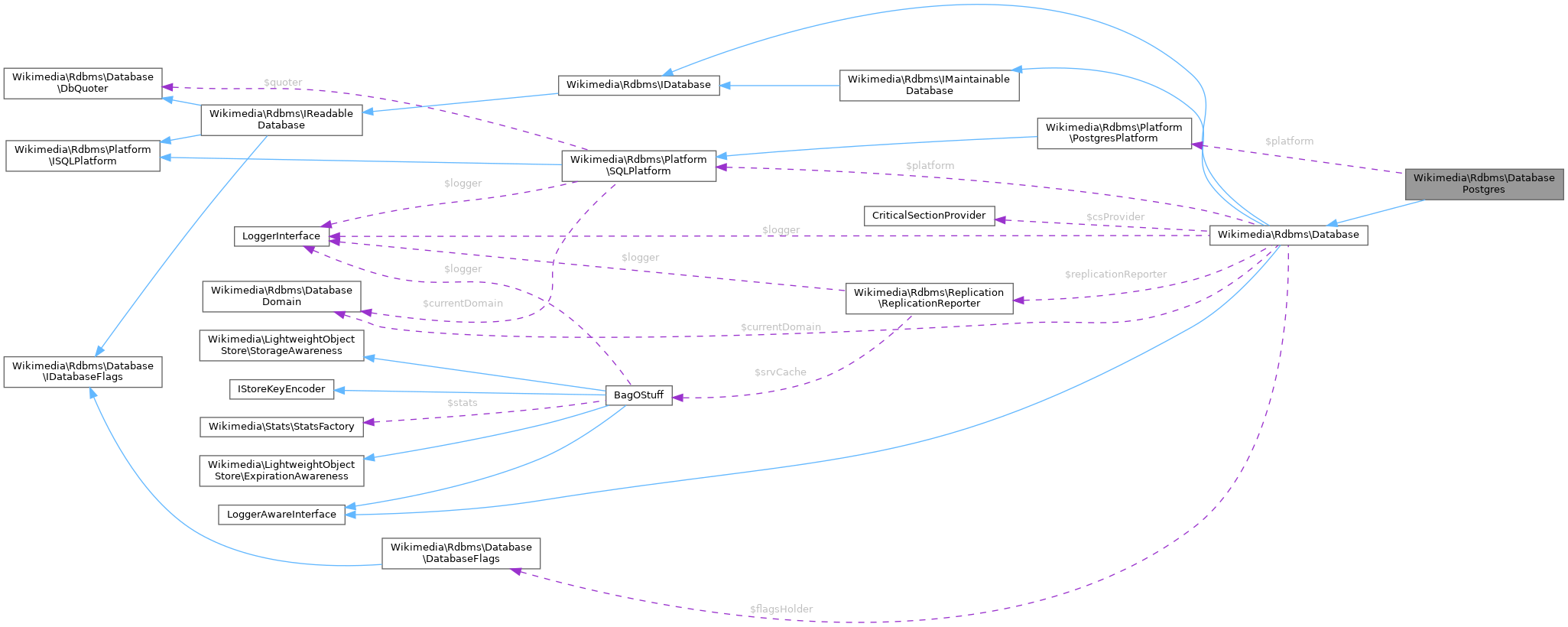
Postgres database abstraction layer. More...
Inherits Wikimedia\Rdbms\Database.
Public Member Functions | |||||||||||||||||||||
| __construct (array $params) | |||||||||||||||||||||
| addQuotes ( $s) | |||||||||||||||||||||
| Escape and quote a raw value string for use in a SQL query. | |||||||||||||||||||||
| constraintExists ( $table, $constraint) | |||||||||||||||||||||
| databasesAreIndependent () | |||||||||||||||||||||
| Returns true if DBs are assumed to be on potentially different servers. | |||||||||||||||||||||
| decodeBlob ( $b) | |||||||||||||||||||||
| Some DBMSs return a special placeholder object representing blob fields in result objects. | |||||||||||||||||||||
| determineCoreSchema ( $desiredSchema) | |||||||||||||||||||||
| Determine default schema for the current application Adjust this session schema search path if desired schema exists and is not already there. | |||||||||||||||||||||
| doLock (string $lockName, string $method, int $timeout) | |||||||||||||||||||||
| doLockIsFree (string $lockName, string $method) | |||||||||||||||||||||
| doSelectDomain (DatabaseDomain $domain) | |||||||||||||||||||||
| doSingleStatementQuery (string $sql) | |||||||||||||||||||||
| Run a query and return a QueryStatus instance with the query result information. | |||||||||||||||||||||
| doUnlock (string $lockName, string $method) | |||||||||||||||||||||
| duplicateTableStructure ( $oldName, $newName, $temporary=false, $fname=__METHOD__) | |||||||||||||||||||||
| Creates a new table with structure copied from existing table. | |||||||||||||||||||||
| encodeBlob ( $b) | |||||||||||||||||||||
| Some DBMSs have a special format for inserting into blob fields, they don't allow simple quoted strings to be inserted. | |||||||||||||||||||||
| estimateRowCount ( $table, $var=' *', $conds='', $fname=__METHOD__, $options=[], $join_conds=[]) | |||||||||||||||||||||
Estimate the number of rows in dataset.MySQL allows you to estimate the number of rows that would be returned by a SELECT query, using EXPLAIN SELECT. The estimate is provided using index cardinality statistics, and is notoriously inaccurate, especially when large numbers of rows have recently been added or deleted.For DBMSs that don't support fast result size estimation, this function will actually perform the SELECT COUNT(*).Takes the same arguments as IDatabase::select().New callers should use newSelectQueryBuilder with SelectQueryBuilder::estimateRowCount instead, which is more readable and less error-prone.
| |||||||||||||||||||||
| fieldInfo ( $table, $field) | |||||||||||||||||||||
| getCoreSchema () | |||||||||||||||||||||
| Return schema name for core application tables. | |||||||||||||||||||||
| getCoreSchemas () | |||||||||||||||||||||
| Return schema names for temporary tables and core application tables. | |||||||||||||||||||||
| getCurrentSchema () | |||||||||||||||||||||
| Return current schema (executes SELECT current_schema()) Needs transaction. | |||||||||||||||||||||
| getSchemas () | |||||||||||||||||||||
| Return list of schemas which are accessible without schema name This is list does not contain magic keywords like "$user" Needs transaction. | |||||||||||||||||||||
| getSearchPath () | |||||||||||||||||||||
| Return search patch for schemas This is different from getSchemas() since it contain magic keywords (like "$user"). | |||||||||||||||||||||
| getServerVersion () | |||||||||||||||||||||
| A string describing the current software version. | |||||||||||||||||||||
| getSoftwareLink () | |||||||||||||||||||||
| Returns a wikitext style link to the DB's website (e.g. | |||||||||||||||||||||
| getType () | |||||||||||||||||||||
| Get the RDBMS type of the server (e.g. | |||||||||||||||||||||
| getValueTypesForWithClause ( $table) | |||||||||||||||||||||
| indexAttributes ( $index, $schema=false) | |||||||||||||||||||||
| indexInfo ( $table, $index, $fname=__METHOD__) | |||||||||||||||||||||
| Get information about an index into an object. | |||||||||||||||||||||
| lastErrno () | |||||||||||||||||||||
| Get the RDBMS-specific error code from the last attempted query statement. | |||||||||||||||||||||
| lastError () | |||||||||||||||||||||
| Get the RDBMS-specific error description from the last attempted query statement. | |||||||||||||||||||||
| listTables ( $prefix='', $fname=__METHOD__) | |||||||||||||||||||||
| roleExists ( $roleName) | |||||||||||||||||||||
| Returns true if a given role (i.e. | |||||||||||||||||||||
| schemaExists ( $schema) | |||||||||||||||||||||
| Query whether a given schema exists. | |||||||||||||||||||||
| sequenceExists ( $sequence) | |||||||||||||||||||||
| serverIsReadOnly () | |||||||||||||||||||||
| |||||||||||||||||||||
| streamStatementEnd (&$sql, &$newLine) | |||||||||||||||||||||
| Called by sourceStream() to check if we've reached a statement end. | |||||||||||||||||||||
| strencode ( $s) | |||||||||||||||||||||
| Wrapper for addslashes() | |||||||||||||||||||||
| tableExists ( $table, $fname=__METHOD__) | |||||||||||||||||||||
| Query whether a given table exists. | |||||||||||||||||||||
| truncateTable ( $table, $fname=__METHOD__) | |||||||||||||||||||||
| Delete all data in a table and reset any sequences owned by that table. | |||||||||||||||||||||
 Public Member Functions inherited from Wikimedia\Rdbms\Database Public Member Functions inherited from Wikimedia\Rdbms\Database | |||||||||||||||||||||
| __clone () | |||||||||||||||||||||
| Make sure that copies do not share the same client binding handle. | |||||||||||||||||||||
| __destruct () | |||||||||||||||||||||
| Run a few simple checks and close dangling connections. | |||||||||||||||||||||
| __sleep () | |||||||||||||||||||||
| Called by serialize. | |||||||||||||||||||||
| __toString () | |||||||||||||||||||||
| Get a debugging string that mentions the database type, the ID of this instance, and the ID of any underlying connection resource or driver object if one is present. | |||||||||||||||||||||
| addIdentifierQuotes ( $s) | |||||||||||||||||||||
| Escape a SQL identifier (e.g. | |||||||||||||||||||||
| affectedRows () | |||||||||||||||||||||
| Get the number of rows affected by the last query method call. | |||||||||||||||||||||
| andExpr (array $conds) | |||||||||||||||||||||
| See Expression::__construct() | |||||||||||||||||||||
| anyChar () | |||||||||||||||||||||
Returns a token for buildLike() that denotes a '_' to be used in a LIKE query. | |||||||||||||||||||||
| anyString () | |||||||||||||||||||||
Returns a token for buildLike() that denotes a '' to be used in a LIKE query. | |||||||||||||||||||||
| begin ( $fname=__METHOD__, $mode=self::TRANSACTION_EXPLICIT) | |||||||||||||||||||||
| Begin a transaction. | |||||||||||||||||||||
| bitAnd ( $fieldLeft, $fieldRight) | |||||||||||||||||||||
| bitNot ( $field) | |||||||||||||||||||||
| bitOr ( $fieldLeft, $fieldRight) | |||||||||||||||||||||
| buildComparison (string $op, array $conds) | |||||||||||||||||||||
| Build a condition comparing multiple values, for use with indexes that cover multiple fields, common when e.g. | |||||||||||||||||||||
| buildConcat ( $stringList) | |||||||||||||||||||||
| Build a concatenation list to feed into a SQL query. | |||||||||||||||||||||
| buildExcludedValue ( $column) | |||||||||||||||||||||
| Build a reference to a column value from the conflicting proposed upsert() row. | |||||||||||||||||||||
| buildGreatest ( $fields, $values) | |||||||||||||||||||||
| Build a GREATEST function statement comparing columns/values. | |||||||||||||||||||||
| buildGroupConcatField ( $delim, $tables, $field, $conds='', $join_conds=[]) | |||||||||||||||||||||
| Build a GROUP_CONCAT or equivalent statement for a query. | |||||||||||||||||||||
| buildIntegerCast ( $field) | |||||||||||||||||||||
| buildLeast ( $fields, $values) | |||||||||||||||||||||
| Build a LEAST function statement comparing columns/values. | |||||||||||||||||||||
| buildLike ( $param,... $params) | |||||||||||||||||||||
| LIKE statement wrapper. | |||||||||||||||||||||
| buildSelectSubquery ( $tables, $vars, $conds='', $fname=__METHOD__, $options=[], $join_conds=[]) | |||||||||||||||||||||
| Equivalent to IDatabase::selectSQLText() except wraps the result in Subquery. | |||||||||||||||||||||
| buildStringCast ( $field) | |||||||||||||||||||||
| buildSubstring ( $input, $startPosition, $length=null) | |||||||||||||||||||||
| cancelAtomic ( $fname=__METHOD__, AtomicSectionIdentifier $sectionId=null) | |||||||||||||||||||||
| Cancel an atomic section of SQL statements. | |||||||||||||||||||||
| clearFlag ( $flag, $remember=self::REMEMBER_NOTHING) | |||||||||||||||||||||
| Clear a flag for this connection. | |||||||||||||||||||||
| close ( $fname=__METHOD__) | |||||||||||||||||||||
| Close the database connection. | |||||||||||||||||||||
| commit ( $fname=__METHOD__, $flush=self::FLUSHING_ONE) | |||||||||||||||||||||
| Commits a transaction previously started using begin() | |||||||||||||||||||||
| conditional ( $cond, $caseTrueExpression, $caseFalseExpression) | |||||||||||||||||||||
| Returns an SQL expression for a simple conditional. | |||||||||||||||||||||
| connectionErrorLogger ( $errno, $errstr) | |||||||||||||||||||||
| Error handler for logging errors during database connection. | |||||||||||||||||||||
| dbSchema ( $schema=null) | |||||||||||||||||||||
| Get/set the db schema. | |||||||||||||||||||||
| decodeExpiry ( $expiry, $format=TS_MW) | |||||||||||||||||||||
| Decode an expiry time into a DBMS independent format. | |||||||||||||||||||||
| delete ( $table, $conds, $fname=__METHOD__) | |||||||||||||||||||||
| Delete all rows in a table that match a condition. | |||||||||||||||||||||
| deleteJoin ( $delTable, $joinTable, $delVar, $joinVar, $conds, $fname=__METHOD__) | |||||||||||||||||||||
| Delete all rows in a table that match a condition which includes a join. | |||||||||||||||||||||
| doAtomicSection ( $fname, callable $callback, $cancelable=self::ATOMIC_NOT_CANCELABLE) | |||||||||||||||||||||
| Perform an atomic section of reversible SQL statements from a callback. | |||||||||||||||||||||
| dropTable ( $table, $fname=__METHOD__) | |||||||||||||||||||||
| Delete a table. | |||||||||||||||||||||
| encodeExpiry ( $expiry) | |||||||||||||||||||||
| Encode an expiry time into the DBMS dependent format. | |||||||||||||||||||||
| endAtomic ( $fname=__METHOD__) | |||||||||||||||||||||
| Ends an atomic section of SQL statements. | |||||||||||||||||||||
| explicitTrxActive () | |||||||||||||||||||||
| Check whether there is a transaction open at the specific request of a caller. | |||||||||||||||||||||
| expr (string $field, string $op, $value) | |||||||||||||||||||||
| See Expression::__construct() | |||||||||||||||||||||
| factorConds ( $condsArray) | |||||||||||||||||||||
| Given an array of condition arrays representing an OR list of AND lists, for example: | |||||||||||||||||||||
| fieldExists ( $table, $field, $fname=__METHOD__) | |||||||||||||||||||||
| Determines whether a field exists in a table. | |||||||||||||||||||||
| flushSession ( $fname=__METHOD__, $flush=self::FLUSHING_ONE) | |||||||||||||||||||||
| Release important session-level state (named lock, table locks) as post-rollback cleanup. | |||||||||||||||||||||
| flushSnapshot ( $fname=__METHOD__, $flush=self::FLUSHING_ONE) | |||||||||||||||||||||
| Commit any transaction but error out if writes or callbacks are pending. | |||||||||||||||||||||
| getDBname () | |||||||||||||||||||||
| Get the current database name; null if there isn't one. | |||||||||||||||||||||
| getDomainID () | |||||||||||||||||||||
| Return the currently selected domain ID. | |||||||||||||||||||||
| getFlag ( $flag) | |||||||||||||||||||||
| Returns a boolean whether the flag $flag is set for this connection. | |||||||||||||||||||||
| getInfinity () | |||||||||||||||||||||
| Find out when 'infinity' is. | |||||||||||||||||||||
| getLag () | |||||||||||||||||||||
| Get the seconds of replication lag on this database server. | |||||||||||||||||||||
| getLBInfo ( $name=null) | |||||||||||||||||||||
| Get properties passed down from the server info array of the load balancer. | |||||||||||||||||||||
| getPrimaryPos () | |||||||||||||||||||||
| Get the replication position of this primary DB server. | |||||||||||||||||||||
| getScopedLockAndFlush ( $lockKey, $fname, $timeout) | |||||||||||||||||||||
| Acquire a named lock, flush any transaction, and return an RAII style unlocker object. | |||||||||||||||||||||
| getServer () | |||||||||||||||||||||
| Get the hostname or IP address of the server. | |||||||||||||||||||||
| getServerInfo () | |||||||||||||||||||||
| Get a human-readable string describing the current software version. | |||||||||||||||||||||
| getServerName () | |||||||||||||||||||||
| Get the readable name for the server. | |||||||||||||||||||||
| getSessionLagStatus () | |||||||||||||||||||||
| Get a cached estimate of the seconds of replication lag on this database server, using the estimate obtained at the start of the current transaction if one is active. | |||||||||||||||||||||
| getTableAliases () | |||||||||||||||||||||
| Return current table aliases. | |||||||||||||||||||||
| implicitOrderby () | |||||||||||||||||||||
| Returns true if this database does an implicit order by when the column has an index For example: SELECT page_title FROM page LIMIT 1. | |||||||||||||||||||||
| indexExists ( $table, $index, $fname=__METHOD__) | |||||||||||||||||||||
| Determines whether an index exists. | |||||||||||||||||||||
| indexUnique ( $table, $index, $fname=__METHOD__) | |||||||||||||||||||||
| Determines if a given index is unique. | |||||||||||||||||||||
| initConnection () | |||||||||||||||||||||
| Initialize the connection to the database over the wire (or to local files) | |||||||||||||||||||||
| insert ( $table, $rows, $fname=__METHOD__, $options=[]) | |||||||||||||||||||||
| Insert row(s) into a table, in the provided order. | |||||||||||||||||||||
| insertId () | |||||||||||||||||||||
| Get the sequence-based ID assigned by the last query method call. | |||||||||||||||||||||
| insertSelect ( $destTable, $srcTable, $varMap, $conds, $fname=__METHOD__, $insertOptions=[], $selectOptions=[], $selectJoinConds=[]) | |||||||||||||||||||||
| INSERT SELECT wrapper. | |||||||||||||||||||||
| isOpen () | |||||||||||||||||||||
| isQuotedIdentifier ( $name) | |||||||||||||||||||||
| isReadOnly () | |||||||||||||||||||||
| Check if this DB server is marked as read-only according to load balancer info. | |||||||||||||||||||||
| lastDoneWrites () | |||||||||||||||||||||
| Get the last time the connection may have been used for a write query. | |||||||||||||||||||||
| limitResult ( $sql, $limit, $offset=false) | |||||||||||||||||||||
| Construct a LIMIT query with optional offset. | |||||||||||||||||||||
| lock ( $lockName, $method, $timeout=5, $flags=0) | |||||||||||||||||||||
Acquire a named lock.Named locks are not related to transactions
| |||||||||||||||||||||
| lockForUpdate ( $table, $conds='', $fname=__METHOD__, $options=[], $join_conds=[]) | |||||||||||||||||||||
| Lock all rows meeting the given conditions/options FOR UPDATE. | |||||||||||||||||||||
| lockIsFree ( $lockName, $method) | |||||||||||||||||||||
Check to see if a named lock is not locked by any thread (non-blocking)
| |||||||||||||||||||||
| makeList (array $a, $mode=self::LIST_COMMA) | |||||||||||||||||||||
| Makes an encoded list of strings from an array. | |||||||||||||||||||||
| makeWhereFrom2d ( $data, $baseKey, $subKey) | |||||||||||||||||||||
| Build a "OR" condition with pairs from a two-dimensional array. | |||||||||||||||||||||
| newDeleteQueryBuilder () | |||||||||||||||||||||
| Get a DeleteQueryBuilder bound to this connection. | |||||||||||||||||||||
| newInsertQueryBuilder () | |||||||||||||||||||||
| Get a InsertQueryBuilder bound to this connection. | |||||||||||||||||||||
| newReplaceQueryBuilder () | |||||||||||||||||||||
| Get a ReplaceQueryBuilder bound to this connection. | |||||||||||||||||||||
| newSelectQueryBuilder () | |||||||||||||||||||||
| Get a SelectQueryBuilder bound to this connection. | |||||||||||||||||||||
| newUnionQueryBuilder () | |||||||||||||||||||||
| Get a UnionQueryBuilder bound to this connection. | |||||||||||||||||||||
| newUpdateQueryBuilder () | |||||||||||||||||||||
| Get an UpdateQueryBuilder bound to this connection. | |||||||||||||||||||||
| onAtomicSectionCancel (callable $callback, $fname=__METHOD__) | |||||||||||||||||||||
| Run a callback when the atomic section is cancelled. | |||||||||||||||||||||
| onTransactionCommitOrIdle (callable $callback, $fname=__METHOD__) | |||||||||||||||||||||
| Run a callback when the current transaction commits or now if there is none. | |||||||||||||||||||||
| onTransactionPreCommitOrIdle (callable $callback, $fname=__METHOD__) | |||||||||||||||||||||
| Run a callback before the current transaction commits or now if there is none. | |||||||||||||||||||||
| onTransactionResolution (callable $callback, $fname=__METHOD__) | |||||||||||||||||||||
| Run a callback when the current transaction commits or rolls back. | |||||||||||||||||||||
| orExpr (array $conds) | |||||||||||||||||||||
| See Expression::__construct() | |||||||||||||||||||||
| pendingWriteAndCallbackCallers () | |||||||||||||||||||||
| pendingWriteCallers () | |||||||||||||||||||||
| Get the list of method names that did write queries for this transaction. | |||||||||||||||||||||
| pendingWriteQueryDuration ( $type=self::ESTIMATE_TOTAL) | |||||||||||||||||||||
| Get the time spend running write queries for this transaction. | |||||||||||||||||||||
| ping () | |||||||||||||||||||||
| Ping the server and try to reconnect if it there is no connection. | |||||||||||||||||||||
| primaryPosWait (DBPrimaryPos $pos, $timeout) | |||||||||||||||||||||
| Wait for the replica server to catch up to a given primary server position. | |||||||||||||||||||||
| query ( $sql, $fname=__METHOD__, $flags=0) | |||||||||||||||||||||
| Run an SQL query statement and return the result. | |||||||||||||||||||||
| replace ( $table, $uniqueKeys, $rows, $fname=__METHOD__) | |||||||||||||||||||||
| Insert row(s) into a table, in the provided order, while deleting conflicting rows. | |||||||||||||||||||||
| reportQueryError ( $error, $errno, $sql, $fname, $ignore=false) | |||||||||||||||||||||
| Report a query error. | |||||||||||||||||||||
| restoreFlags ( $state=self::RESTORE_PRIOR) | |||||||||||||||||||||
| Restore the flags to their prior state before the last setFlag/clearFlag call. | |||||||||||||||||||||
| rollback ( $fname=__METHOD__, $flush=self::FLUSHING_ONE) | |||||||||||||||||||||
| Rollback a transaction previously started using begin() | |||||||||||||||||||||
| runOnTransactionIdleCallbacks ( $trigger, array &$errors=[]) | |||||||||||||||||||||
| Consume and run any "on transaction idle/resolution" callbacks. | |||||||||||||||||||||
| runOnTransactionPreCommitCallbacks () | |||||||||||||||||||||
| runTransactionListenerCallbacks ( $trigger, array &$errors=[]) | |||||||||||||||||||||
| Actually run any "transaction listener" callbacks. | |||||||||||||||||||||
| select ( $tables, $vars, $conds='', $fname=__METHOD__, $options=[], $join_conds=[]) | |||||||||||||||||||||
| Execute a SELECT query constructed using the various parameters provided. | |||||||||||||||||||||
| selectDomain ( $domain) | |||||||||||||||||||||
| Set the current domain (database, schema, and table prefix) | |||||||||||||||||||||
| selectField ( $tables, $var, $cond='', $fname=__METHOD__, $options=[], $join_conds=[]) | |||||||||||||||||||||
| A SELECT wrapper which returns a single field from a single result row. | |||||||||||||||||||||
| selectFieldValues ( $tables, $var, $cond='', $fname=__METHOD__, $options=[], $join_conds=[]) | |||||||||||||||||||||
| A SELECT wrapper which returns a list of single field values from result rows. | |||||||||||||||||||||
| selectRow ( $tables, $vars, $conds, $fname=__METHOD__, $options=[], $join_conds=[]) | |||||||||||||||||||||
| Wrapper to IDatabase::select() that only fetches one row (via LIMIT) | |||||||||||||||||||||
| selectRowCount ( $tables, $var=' *', $conds='', $fname=__METHOD__, $options=[], $join_conds=[]) | |||||||||||||||||||||
| Get the number of rows in dataset. | |||||||||||||||||||||
| selectSQLText ( $tables, $vars, $conds='', $fname=__METHOD__, $options=[], $join_conds=[]) | |||||||||||||||||||||
| Take the same arguments as IDatabase::select() and return the SQL it would use. | |||||||||||||||||||||
| sessionLocksPending () | |||||||||||||||||||||
| setFlag ( $flag, $remember=self::REMEMBER_NOTHING) | |||||||||||||||||||||
| Set a flag for this connection. | |||||||||||||||||||||
| setIndexAliases (array $aliases) | |||||||||||||||||||||
| Convert certain index names to alternative names before querying the DB. | |||||||||||||||||||||
| setLBInfo ( $nameOrArray, $value=null) | |||||||||||||||||||||
| Set the entire array or a particular key of the managing load balancer info array. | |||||||||||||||||||||
| setLogger (LoggerInterface $logger) | |||||||||||||||||||||
| Set the PSR-3 logger interface to use. | |||||||||||||||||||||
| setSchemaVars ( $vars) | |||||||||||||||||||||
| Set schema variables to be used when streaming commands from SQL files or stdin. | |||||||||||||||||||||
| setSessionOptions (array $options) | |||||||||||||||||||||
| Override database's default behavior. | |||||||||||||||||||||
| setTableAliases (array $aliases) | |||||||||||||||||||||
| Make certain table names use their own database, schema, and table prefix when passed into SQL queries pre-escaped and without a qualified database name. | |||||||||||||||||||||
| setTransactionListener ( $name, callable $callback=null) | |||||||||||||||||||||
| Run a callback after each time any transaction commits or rolls back. | |||||||||||||||||||||
| setTransactionManager (TransactionManager $transactionManager) | |||||||||||||||||||||
| setTrxEndCallbackSuppression ( $suppress) | |||||||||||||||||||||
| Whether to disable running of post-COMMIT/ROLLBACK callbacks. | |||||||||||||||||||||
| sourceFile ( $filename, callable $lineCallback=null, callable $resultCallback=null, $fname=false, callable $inputCallback=null) | |||||||||||||||||||||
| Read and execute SQL commands from a file. | |||||||||||||||||||||
| sourceStream ( $fp, callable $lineCallback=null, callable $resultCallback=null, $fname=__METHOD__, callable $inputCallback=null) | |||||||||||||||||||||
| Read and execute commands from an open file handle. | |||||||||||||||||||||
| startAtomic ( $fname=__METHOD__, $cancelable=self::ATOMIC_NOT_CANCELABLE) | |||||||||||||||||||||
| Begin an atomic section of SQL statements. | |||||||||||||||||||||
| strreplace ( $orig, $old, $new) | |||||||||||||||||||||
| Returns a SQL expression for simple string replacement (e.g. | |||||||||||||||||||||
| tableName (string $name, $format='quoted') | |||||||||||||||||||||
| Format a table name ready for use in constructing an SQL query. | |||||||||||||||||||||
| tableNames (... $tables) | |||||||||||||||||||||
| Fetch a number of table names into an associative array. | |||||||||||||||||||||
| tableNamesN (... $tables) | |||||||||||||||||||||
| Fetch a number of table names into a zero-indexed numerical array. | |||||||||||||||||||||
| tablePrefix ( $prefix=null) | |||||||||||||||||||||
| Get/set the table prefix. | |||||||||||||||||||||
| timestamp ( $ts=0) | |||||||||||||||||||||
Convert a timestamp in one of the formats accepted by ConvertibleTimestamp to the format used for inserting into timestamp fields in this DBMS. | |||||||||||||||||||||
| timestampOrNull ( $ts=null) | |||||||||||||||||||||
| Convert a timestamp in one of the formats accepted by ConvertibleTimestamp to the format used for inserting into timestamp fields in this DBMS. | |||||||||||||||||||||
| trxLevel () | |||||||||||||||||||||
| Gets the current transaction level. | |||||||||||||||||||||
| trxStatus () | |||||||||||||||||||||
| trxTimestamp () | |||||||||||||||||||||
| Get the UNIX timestamp of the time that the transaction was established. | |||||||||||||||||||||
| unionQueries ( $sqls, $all, $options=[]) | |||||||||||||||||||||
| Construct a UNION query. | |||||||||||||||||||||
| unionSupportsOrderAndLimit () | |||||||||||||||||||||
| Determine if the RDBMS supports ORDER BY and LIMIT for separate subqueries within UNION. | |||||||||||||||||||||
| unlock ( $lockName, $method) | |||||||||||||||||||||
Release a lock.Named locks are not related to transactions
| |||||||||||||||||||||
| update ( $table, $set, $conds, $fname=__METHOD__, $options=[]) | |||||||||||||||||||||
| Update all rows in a table that match a given condition. | |||||||||||||||||||||
| upsert ( $table, array $rows, $uniqueKeys, array $set, $fname=__METHOD__) | |||||||||||||||||||||
| Upsert row(s) into a table, in the provided order, while updating conflicting rows. | |||||||||||||||||||||
| writesOrCallbacksPending () | |||||||||||||||||||||
| Whether there is a transaction open with either possible write queries or unresolved pre-commit/commit/resolution callbacks pending. | |||||||||||||||||||||
| writesPending () | |||||||||||||||||||||
| Public Member Functions inherited from Wikimedia\Rdbms\Platform\ISQLPlatform | |||||||||||||||||||||
| buildSubString ( $input, $startPosition, $length=null) | |||||||||||||||||||||
| Build a SUBSTRING function. | |||||||||||||||||||||
Static Public Member Functions | |
| static | getAttributes () |
| Static Public Member Functions inherited from Wikimedia\Rdbms\Database | |
| static | getCacheSetOptions (?IReadableDatabase ... $dbs) |
| Merge the result of getSessionLagStatus() for several DBs using the most pessimistic values to estimate the lag of any data derived from them in combination. | |
Protected Member Functions | |
| closeConnection () | |
| Closes underlying database connection. | |
| doFlushSession ( $fname) | |
| Reset the server-side session state for named locks and table locks. | |
| doInsertSelectNative ( $destTable, $srcTable, array $varMap, $conds, $fname, array $insertOptions, array $selectOptions, $selectJoinConds) | |
| Native server-side implementation of insertSelect() for situations where we don't want to select everything into memory. | |
| dumpError () | |
| getInsertIdColumnForUpsert ( $table) | |
| isConnectionError ( $errno) | |
| Do not use this method outside of Database/DBError classes. | |
| isKnownStatementRollbackError ( $errno) | |
| isQueryTimeoutError ( $errno) | |
| Checks whether the cause of the error is detected to be a timeout. | |
| lastInsertId () | |
| Get a row ID from the last insert statement to implicitly assign one within the session. | |
| open ( $server, $user, $password, $db, $schema, $tablePrefix) | |
| Open a new connection to the database (closing any existing one) | |
| Protected Member Functions inherited from Wikimedia\Rdbms\Database | |
| assertHasConnectionHandle () | |
| Make sure there is an open connection handle (alive or not) | |
| checkInsertWarnings (Query $query, $fname) | |
| Check for warnings after performing an INSERT query, and throw exceptions if necessary. | |
| commenceCriticalSection (string $fname) | |
| Demark the start of a critical section of session/transaction state changes. | |
| completeCriticalSection (string $fname, ?CriticalSectionScope $csm, Throwable $trxError=null) | |
| Demark the completion of a critical section of session/transaction state changes. | |
| doBegin ( $fname) | |
| Issues the BEGIN command to the database server. | |
| doHandleSessionLossPreconnect () | |
| Reset any additional subclass trx* and session* fields. | |
| executeQuery ( $sql, $fname, $flags) | |
| Execute a query without enforcing public (non-Database) caller restrictions. | |
| getBindingHandle () | |
| Get the underlying binding connection handle. | |
| getLastPHPError () | |
| getLogContext (array $extras=[]) | |
| Create a log context to pass to PSR-3 logger functions. | |
| getReadOnlyReason () | |
| getTransactionRoundId () | |
| installErrorHandler () | |
| Set a custom error handler for logging errors during database connection. | |
| isInsertSelectSafe (array $insertOptions, array $selectOptions, $fname=__METHOD__) | |
| newExceptionAfterConnectError ( $error) | |
| registerTempTables (Query $query) | |
| Register creation and dropping of temporary tables. | |
| replaceLostConnection ( $lastErrno, $fname) | |
| Close any existing (dead) database connection and open a new connection. | |
| restoreErrorHandler () | |
| Restore the previous error handler and return the last PHP error for this DB. | |
Protected Attributes | |
| PostgresPlatform | $platform |
| Protected Attributes inherited from Wikimedia\Rdbms\Database | |
| string | $agent |
| Agent name for query profiling. | |
| bool | $cliMode |
| Whether this PHP instance is for a CLI script. | |
| object resource null | $conn |
| Database connection. | |
| array< string, mixed > | $connectionParams |
| Connection parameters used by initConnection() and open() | |
| string[] int[] float[] | $connectionVariables |
| SQL variables values to use for all new connections. | |
| int null | $connectTimeout |
| Maximum seconds to wait on connection attempts. | |
| CriticalSectionProvider null | $csProvider |
| DatabaseDomain | $currentDomain |
| string false | $delimiter = ';' |
| Current SQL query delimiter. | |
| callable | $deprecationLogger |
| Deprecation logging callback. | |
| callable | $errorLogger |
| Error logging callback. | |
| DatabaseFlags | $flagsHolder |
| array | $lbInfo = [] |
| Current LoadBalancer tracking information. | |
| LoggerInterface | $logger |
| int | $nonNativeInsertSelectBatchSize |
| Row batch size to use for emulated INSERT SELECT queries. | |
| callable null | $profiler |
| int null | $receiveTimeout |
| Maximum seconds to wait on receiving query results. | |
| string null | $serverName |
| Readable name or host/IP of the database server. | |
| array< string, array > | $sessionNamedLocks = [] |
| Map of (lock name => (UNIX time,trx ID)) | |
| bool | $ssl |
| Whether to use SSL connections. | |
| bool | $strictWarnings |
| Whether to check for warnings. | |
| array< string, array< string, $sessionTempTables=[];protected int $lastQueryAffectedRows=0;protected int|null $lastQueryInsertId;protected int|null $lastEmulatedAffectedRows;protected int|null $lastEmulatedInsertId;protected string $lastConnectError='';private float $lastPing=0.0;private float|false $lastWriteTime=false;private string|false $lastPhpError=false;private int|null $csmId;private string|null $csmFname;private DBUnexpectedError|null $csmError;public const ATTR_DB_IS_FILE='db-is-file';public const ATTR_DB_LEVEL_LOCKING='db-level-locking';public const ATTR_SCHEMAS_AS_TABLE_GROUPS='supports-schemas';public const NEW_UNCONNECTED=0;public const NEW_CONNECTED=1;protected const ERR_NONE=0;protected const ERR_RETRY_QUERY=1;protected const ERR_ABORT_QUERY=2;protected const ERR_ABORT_TRX=4;protected const ERR_ABORT_SESSION=8;protected const DROPPED_CONN_BLAME_THRESHOLD_SEC=3.0;=private const NOT_APPLICABLE 'n/a';private const PING_TTL=1.0;private const PING_QUERY='SELECT 1 AS ping';protected const CONN_HOST='host';protected const CONN_USER='user';protected const CONN_PASSWORD='password';protected const CONN_INITIAL_DB='dbname';protected const CONN_INITIAL_SCHEMA='schema';protected const CONN_INITIAL_TABLE_PREFIX='tablePrefix';protected SQLPlatform $platform;protected ReplicationReporter $replicationReporter;public function __construct(array $params) { $this->logger=$params[ 'logger'] ?? new NullLogger();$this-> | transactionManager |
| TempTableInfo>> Map of (DB name => table name => info) | |
Additional Inherited Members | |
| Public Attributes inherited from Wikimedia\Rdbms\Database | |
| if(is_string( $params['sqlMode'] ?? null)) | $flags = (int)$params['flags'] |
| $this | agent = (string)$params['agent'] |
| $this | cliMode = (bool)$params['cliMode'] |
| $this | connectionParams |
| $this | connectionVariables = $params['variables'] ?? [] |
| $this | connectTimeout = $params['connectTimeout'] ?? null |
| $this | csProvider = $params['criticalSectionProvider'] ?? null |
| $this | currentDomain |
| $this | deprecationLogger = $params['deprecationLogger'] |
| $this | errorLogger = $params['errorLogger'] |
| $this | flagsHolder = new DatabaseFlags( $flags ) |
| $this | lbInfo = $params['lbInfo'] ?? [] |
| $this | nonNativeInsertSelectBatchSize = $params['nonNativeInsertSelectBatchSize'] ?? 10000 |
| $this | platform |
| $this | profiler = is_callable( $params['profiler'] ) ? $params['profiler'] : null |
| $this | receiveTimeout = $params['receiveTimeout'] ?? null |
| $this | serverName = $params['serverName'] |
| $this | ssl = $params['ssl'] ?? (bool)( $flags & self::DBO_SSL ) |
| $this | strictWarnings = !empty( $params['strictWarnings'] ) |
| Public Attributes inherited from Wikimedia\Rdbms\IDatabase | |
| const | ATOMIC_CANCELABLE = 'cancelable' |
| Atomic section is cancelable. | |
| const | ATOMIC_NOT_CANCELABLE = '' |
| Atomic section is not cancelable. | |
| const | ESTIMATE_DB_APPLY = 'apply' |
| Estimate time to apply (scanning, applying) | |
| const | ESTIMATE_TOTAL = 'total' |
| Estimate total time (RTT, scanning, waiting on locks, applying) | |
| const | FLUSHING_ALL_PEERS = 'flush' |
| Commit/rollback is from the connection manager for the IDatabase handle. | |
| const | FLUSHING_INTERNAL = 'flush-internal' |
| Commit/rollback is from the IDatabase handle internally. | |
| const | FLUSHING_ONE = '' |
| Commit/rollback is from outside the IDatabase handle and connection manager. | |
| const | LB_READ_ONLY_REASON = 'readOnlyReason' |
| Field for getLBInfo()/setLBInfo() | |
| const | LB_TRX_ROUND_ID = 'trxRoundId' |
| Field for getLBInfo()/setLBInfo() | |
| const | LOCK_TIMESTAMP = 1 |
| Flag to return the lock acquisition timestamp (null if not acquired) | |
| const | ROLE_STATIC_CLONE = 'static-clone' |
| Replica server within a static dataset. | |
| const | ROLE_STREAMING_MASTER = 'streaming-master' |
| Primary server than can stream writes to replica servers. | |
| const | ROLE_STREAMING_REPLICA = 'streaming-replica' |
| Replica server that receives writes from a primary server. | |
| const | ROLE_UNKNOWN = 'unknown' |
| Server with unknown topology role. | |
| const | TRANSACTION_EXPLICIT = '' |
| Transaction is requested by regular caller outside of the DB layer. | |
| const | TRANSACTION_INTERNAL = 'implicit' |
| Transaction is requested internally via DBO_TRX/startAtomic() | |
| const | TRIGGER_CANCEL = 4 |
| Callback triggered by atomic section cancel (ROLLBACK TO SAVEPOINT) | |
| const | TRIGGER_COMMIT = 2 |
| Callback triggered by COMMIT. | |
| const | TRIGGER_IDLE = 1 |
| Callback triggered immediately due to no active transaction. | |
| const | TRIGGER_ROLLBACK = 3 |
| Callback triggered by ROLLBACK. | |
| Public Attributes inherited from Wikimedia\Rdbms\IReadableDatabase | |
| const | UNION_ALL = true |
| Parameter to unionQueries() for UNION ALL. | |
| const | UNION_DISTINCT = false |
| Parameter to unionQueries() for UNION DISTINCT. | |
| Public Attributes inherited from Wikimedia\Rdbms\Platform\ISQLPlatform | |
| const | ALL_ROWS = '*' |
| Unconditional update/delete of whole table. | |
| const | CALLER_SUBQUERY = 'subquery' |
| Special value for ->caller() / $fname parameter used when providing a caller is not expected, because we're formatting a subquery that won't be executed directly. | |
| const | CALLER_UNKNOWN = 'unknown' |
| Special value for ->caller() / $fname parameter used when a caller is not provided. | |
| const | LIST_AND = 1 |
| Combine list with AND clauses. | |
| const | LIST_COMMA = 0 |
| Combine list with comma delimiters. | |
| const | LIST_NAMES = 3 |
| Treat as field name and do not apply value escaping. | |
| const | LIST_OR = 4 |
| Combine list with OR clauses. | |
| const | LIST_SET = 2 |
| Convert map into a SET clause. | |
| const | QUERY_CHANGE_LOCKS = 512 |
| Query is a command for advisory locks. | |
| const | QUERY_CHANGE_NONE = 32 |
| Query is a read-only Data Query Language query. | |
| const | QUERY_CHANGE_ROWS = 128 |
| Query is a Data Manipulation Language command (INSERT, DELETE, LOCK, ...) | |
| const | QUERY_CHANGE_SCHEMA = 256 |
| Query is a Data Definition Language command. | |
| const | QUERY_CHANGE_TRX = 64 |
| Query is a Transaction Control Language command (BEGIN, USE, SET, ...) | |
| const | QUERY_IGNORE_DBO_TRX = 8 |
| Ignore the current presence of any DBO_TRX flag. | |
| const | QUERY_NO_RETRY = 16 |
| Do not try to retry the query if the connection was lost. | |
| const | QUERY_NORMAL = 0 |
| Idiom for "no special flags". | |
| const | QUERY_PSEUDO_PERMANENT = 2 |
| Track a TEMPORARY table CREATE as if it was for a permanent table (for testing) | |
| const | QUERY_REPLICA_ROLE = 4 |
| Enforce that a query does not make effective writes. | |
| const | QUERY_SILENCE_ERRORS = 1 |
| Ignore query errors and return false when they happen. | |
| Public Attributes inherited from Wikimedia\Rdbms\Database\IDatabaseFlags | |
| const | DBO_COMPRESS = 512 |
| Enable compression in connection protocol. | |
| const | DBO_DDLMODE = 128 |
| Schema file mode; was used by Oracle. | |
| const | DBO_DEBUG = 1 |
| Enable debug logging of all SQL queries. | |
| const | DBO_DEFAULT = 16 |
| Join load balancer transaction rounds (which control DBO_TRX) in non-CLI mode. | |
| const | DBO_GAUGE = 1024 |
| Optimize connection for guaging server state (e.g. | |
| const | DBO_IGNORE = 4 |
| Unused since 1.31. | |
| const | DBO_NOBUFFER = 2 |
| Unused since 1.34. | |
| const | DBO_PERSISTENT = 32 |
| Use DB persistent connections if possible. | |
| const | DBO_SSL = 256 |
| Enable SSL/TLS in connection protocol. | |
| const | DBO_SYSDBA = 64 |
| DBA session mode; was used by Oracle. | |
| const | DBO_TRX = 8 |
| Automatically start a transaction before running a query if none is active. | |
| const | REMEMBER_NOTHING = '' |
| Do not remember the prior flags. | |
| const | REMEMBER_PRIOR = 'remember' |
| Remember the prior flags. | |
| const | RESTORE_INITIAL = 'initial' |
| Restore to the initial flag state. | |
| const | RESTORE_PRIOR = 'prior' |
| Restore to the prior flag state. | |
Detailed Description
Postgres database abstraction layer.
Definition at line 36 of file DatabasePostgres.php.
Constructor & Destructor Documentation
◆ __construct()
| Wikimedia\Rdbms\DatabasePostgres::__construct | ( | array | $params | ) |
- See also
- Database::__construct()
- Parameters
-
array $params Additional parameters include: - port: A port to append to the hostname
Definition at line 55 of file DatabasePostgres.php.
References $params, Wikimedia\Rdbms\Database\currentDomain, Wikimedia\Rdbms\Database\errorLogger, and Wikimedia\Rdbms\Database\platform.
Member Function Documentation
◆ addQuotes()
| Wikimedia\Rdbms\DatabasePostgres::addQuotes | ( | $s | ) |
Escape and quote a raw value string for use in a SQL query.
- Parameters
-
?scalar | RawSQLValue | Blob $s
- Returns
- string
Reimplemented from Wikimedia\Rdbms\Database.
Definition at line 907 of file DatabasePostgres.php.
Referenced by Wikimedia\Rdbms\PostgresField\fromText(), and Wikimedia\Rdbms\DatabasePostgres\open().
◆ closeConnection()
|
protected |
Closes underlying database connection.
- Returns
- bool Whether connection was closed successfully
- Since
- 1.20
Reimplemented from Wikimedia\Rdbms\Database.
Definition at line 189 of file DatabasePostgres.php.
◆ constraintExists()
| Wikimedia\Rdbms\DatabasePostgres::constraintExists | ( | $table, | |
| $constraint ) |
Definition at line 819 of file DatabasePostgres.php.
◆ databasesAreIndependent()
| Wikimedia\Rdbms\DatabasePostgres::databasesAreIndependent | ( | ) |
Returns true if DBs are assumed to be on potentially different servers.
In systems like mysql/mariadb, different databases can easily be referenced on a single connection merely by name, even in a single query via JOIN. On the other hand, Postgres treats databases as logically separate, with different database users, requiring special mechanisms like postgres_fdw to "mount" foreign DBs. This is true even among DBs on the same server. Changing the selected database via selectDomain() requires a new connection.
- Returns
- bool
- Since
- 1.29
Reimplemented from Wikimedia\Rdbms\Database.
Definition at line 143 of file DatabasePostgres.php.
◆ decodeBlob()
| Wikimedia\Rdbms\DatabasePostgres::decodeBlob | ( | $b | ) |
Some DBMSs return a special placeholder object representing blob fields in result objects.
Pass the object through this function to return the original string.
- Parameters
-
string | Blob $b
- Returns
- string
- Exceptions
-
DBError
Reimplemented from Wikimedia\Rdbms\Database.
Definition at line 892 of file DatabasePostgres.php.
◆ determineCoreSchema()
| Wikimedia\Rdbms\DatabasePostgres::determineCoreSchema | ( | $desiredSchema | ) |
Determine default schema for the current application Adjust this session schema search path if desired schema exists and is not already there.
We need to have name of the core schema stored to be able to query database metadata.
This will be also called by the installer after the schema is created
- Since
- 1.19
- Parameters
-
string | null $desiredSchema
Definition at line 702 of file DatabasePostgres.php.
Referenced by Wikimedia\Rdbms\DatabasePostgres\open().
◆ doFlushSession()
|
protected |
Reset the server-side session state for named locks and table locks.
Connection and query errors will be suppressed and logged
- Parameters
-
string $fname
- Since
- 1.38
Reimplemented from Wikimedia\Rdbms\Database.
Definition at line 996 of file DatabasePostgres.php.
◆ doInsertSelectNative()
|
protected |
Native server-side implementation of insertSelect() for situations where we don't want to select everything into memory.
- See also
- IDatabase::insertSelect()
- Parameters
-
string $destTable Unqualified name of destination table string | array $srcTable Unqualified name of source table array $varMap array $conds string $fname array $insertOptions array $selectOptions array $selectJoinConds
- Since
- 1.35
Reimplemented from Wikimedia\Rdbms\Database.
Definition at line 388 of file DatabasePostgres.php.
◆ doLock()
| Wikimedia\Rdbms\DatabasePostgres::doLock | ( | string | $lockName, |
| string | $method, | ||
| int | $timeout ) |
- See also
- lock()
- Parameters
-
string $lockName string $method int $timeout
- Returns
- float|null UNIX timestamp of lock acquisition; null on failure
- Exceptions
-
DBError
Reimplemented from Wikimedia\Rdbms\Database.
Definition at line 956 of file DatabasePostgres.php.
◆ doLockIsFree()
| Wikimedia\Rdbms\DatabasePostgres::doLockIsFree | ( | string | $lockName, |
| string | $method ) |
- See also
- lockIsFree()
- Parameters
-
string $lockName string $method
- Returns
- bool Success
- Exceptions
-
DBError
Reimplemented from Wikimedia\Rdbms\Database.
Definition at line 944 of file DatabasePostgres.php.
◆ doSelectDomain()
| Wikimedia\Rdbms\DatabasePostgres::doSelectDomain | ( | DatabaseDomain | $domain | ) |
- Parameters
-
DatabaseDomain $domain
- Exceptions
-
DBConnectionError DBError
- Since
- 1.32
Reimplemented from Wikimedia\Rdbms\Database.
Definition at line 147 of file DatabasePostgres.php.
References Wikimedia\Rdbms\Database\connectionParams, Wikimedia\Rdbms\Database\currentDomain, Wikimedia\Rdbms\DatabaseDomain\getDatabase(), Wikimedia\Rdbms\Database\getDBname(), Wikimedia\Rdbms\DatabaseDomain\getSchema(), Wikimedia\Rdbms\DatabaseDomain\getTablePrefix(), Wikimedia\Rdbms\DatabasePostgres\open(), and Wikimedia\Rdbms\Database\platform.
◆ doSingleStatementQuery()
| Wikimedia\Rdbms\DatabasePostgres::doSingleStatementQuery | ( | string | $sql | ) |
Run a query and return a QueryStatus instance with the query result information.
This is meant to handle the basic command of actually sending a query to the server via the driver. No implicit transaction, reconnection, nor retry logic should happen here. The higher level query() method is designed to handle those sorts of concerns. This method should not trigger such higher level methods.
The lastError() and lastErrno() methods should meaningfully reflect what error, if any, occurred during the last call to this method. Methods like executeQuery(), query(), select(), insert(), update(), delete(), and upsert() implement their calls to doQuery() such that an immediately subsequent call to lastError()/lastErrno() meaningfully reflects any error that occurred during that public query method call.
For SELECT queries, the result field contains either:
- a) A driver-specific IResultWrapper describing the query results
- b) False, on any query failure
For non-SELECT queries, the result field contains either:
- a) A driver-specific IResultWrapper, only on success
- b) True, only on success (e.g. no meaningful result other than "OK")
- c) False, on any query failure
- Parameters
-
string $sql Single-statement SQL query
- Returns
- QueryStatus
- Since
- 1.39
Reimplemented from Wikimedia\Rdbms\Database.
Definition at line 193 of file DatabasePostgres.php.
◆ doUnlock()
| Wikimedia\Rdbms\DatabasePostgres::doUnlock | ( | string | $lockName, |
| string | $method ) |
- See also
- unlock()
- Parameters
-
string $lockName string $method
- Returns
- bool Success
- Exceptions
-
DBError
Reimplemented from Wikimedia\Rdbms\Database.
Definition at line 984 of file DatabasePostgres.php.
◆ dumpError()
|
protected |
Definition at line 223 of file DatabasePostgres.php.
◆ duplicateTableStructure()
| Wikimedia\Rdbms\DatabasePostgres::duplicateTableStructure | ( | $oldName, | |
| $newName, | |||
| $temporary = false, | |||
| $fname = __METHOD__ ) |
Creates a new table with structure copied from existing table.
Note that unlike most database abstraction functions, this function does not automatically append database prefix, because it works at a lower abstraction level. The table names passed to this function shall not be quoted (this function calls addIdentifierQuotes() when needed).
- Parameters
-
string $oldName Name of table whose structure should be copied string $newName Name of table to be created bool $temporary Whether the new table should be temporary string $fname Calling function name
- Returns
- bool True if operation was successful
- Exceptions
-
RuntimeException
Reimplemented from Wikimedia\Rdbms\Database.
Definition at line 460 of file DatabasePostgres.php.
◆ encodeBlob()
| Wikimedia\Rdbms\DatabasePostgres::encodeBlob | ( | $b | ) |
Some DBMSs have a special format for inserting into blob fields, they don't allow simple quoted strings to be inserted.
To insert into such a field, pass the data through this function before passing it to IDatabase::insert().
- Parameters
-
string $b
- Returns
- string|Blob
- Exceptions
-
DBError
Reimplemented from Wikimedia\Rdbms\Database.
Definition at line 886 of file DatabasePostgres.php.
◆ estimateRowCount()
| Wikimedia\Rdbms\DatabasePostgres::estimateRowCount | ( | $tables, | |
| $var = '*', | |||
| $conds = '', | |||
| $fname = __METHOD__, | |||
| $options = [], | |||
| $join_conds = [] ) |
Estimate the number of rows in dataset.MySQL allows you to estimate the number of rows that would be returned by a SELECT query, using EXPLAIN SELECT. The estimate is provided using index cardinality statistics, and is notoriously inaccurate, especially when large numbers of rows have recently been added or deleted.For DBMSs that don't support fast result size estimation, this function will actually perform the SELECT COUNT(*).Takes the same arguments as IDatabase::select().New callers should use newSelectQueryBuilder with SelectQueryBuilder::estimateRowCount instead, which is more readable and less error-prone.
- Access: internal
- Parameters
-
string | string[] $tables Unqualified name of table(s) string $var Column for which NULL values are not counted [default "*"] string|IExpression|array<string,?scalar|non-empty-array<int,?scalar>|RawSQLValue>|array<int,string|IExpression> $conds Filters on the table string $fname Function name for profiling array $options Options for select array | string $join_conds Join conditions
- Returns
- int Row count
- Exceptions
-
DBError If an error occurs, {
- See also
- query}
Reimplemented from Wikimedia\Rdbms\Database.
Definition at line 280 of file DatabasePostgres.php.
◆ fieldInfo()
| Wikimedia\Rdbms\DatabasePostgres::fieldInfo | ( | $table, | |
| $field ) |
- Parameters
-
string $table string $field
- Returns
- PostgresField|null
Implements Wikimedia\Rdbms\IMaintainableDatabase.
Definition at line 882 of file DatabasePostgres.php.
◆ getAttributes()
|
static |
- Returns
- array Map of (Database::ATTR_* constant => value)
- Since
- 1.31
Reimplemented from Wikimedia\Rdbms\Database.
Definition at line 1053 of file DatabasePostgres.php.
◆ getCoreSchema()
| Wikimedia\Rdbms\DatabasePostgres::getCoreSchema | ( | ) |
Return schema name for core application tables.
- Since
- 1.19
- Returns
- string Core schema name
Definition at line 740 of file DatabasePostgres.php.
◆ getCoreSchemas()
| Wikimedia\Rdbms\DatabasePostgres::getCoreSchemas | ( | ) |
Return schema names for temporary tables and core application tables.
- Since
- 1.31
- Returns
- string[] schema names
Definition at line 750 of file DatabasePostgres.php.
Referenced by Wikimedia\Rdbms\PostgresField\fromText().
◆ getCurrentSchema()
| Wikimedia\Rdbms\DatabasePostgres::getCurrentSchema | ( | ) |
Return current schema (executes SELECT current_schema()) Needs transaction.
- Since
- 1.19
- Returns
- string Default schema for the current session
Definition at line 612 of file DatabasePostgres.php.
◆ getInsertIdColumnForUpsert()
|
protected |
- Parameters
-
string $table Unqualified name of table
- Returns
- string|null The AUTO_INCREMENT/SERIAL column; null if not needed
Reimplemented from Wikimedia\Rdbms\Database.
Definition at line 1020 of file DatabasePostgres.php.
◆ getSchemas()
| Wikimedia\Rdbms\DatabasePostgres::getSchemas | ( | ) |
Return list of schemas which are accessible without schema name This is list does not contain magic keywords like "$user" Needs transaction.
- See also
- getSearchPath()
- setSearchPath()
- Since
- 1.19
- Returns
- array List of actual schemas for the current session
Definition at line 634 of file DatabasePostgres.php.
◆ getSearchPath()
| Wikimedia\Rdbms\DatabasePostgres::getSearchPath | ( | ) |
Return search patch for schemas This is different from getSchemas() since it contain magic keywords (like "$user").
Needs transaction
- Since
- 1.19
- Returns
- array How to search for table names schemas for the current user
Definition at line 658 of file DatabasePostgres.php.
◆ getServerVersion()
| Wikimedia\Rdbms\DatabasePostgres::getServerVersion | ( | ) |
A string describing the current software version.
- Returns
- string Version information from the database server.
Implements Wikimedia\Rdbms\IReadableDatabase.
Definition at line 769 of file DatabasePostgres.php.
◆ getSoftwareLink()
| Wikimedia\Rdbms\DatabasePostgres::getSoftwareLink | ( | ) |
Returns a wikitext style link to the DB's website (e.g.
"[https://www.mysql.com/ MySQL]")
Should at least contain plain text, if for some reason your database has no website.
- Returns
- string Wikitext of a link to the server software's web site
Implements Wikimedia\Rdbms\IReadableDatabase.
Definition at line 601 of file DatabasePostgres.php.
◆ getType()
| Wikimedia\Rdbms\DatabasePostgres::getType | ( | ) |
Get the RDBMS type of the server (e.g.
"mysql", "sqlite")
- Returns
- string
Implements Wikimedia\Rdbms\IReadableDatabase.
Definition at line 72 of file DatabasePostgres.php.
◆ getValueTypesForWithClause()
| Wikimedia\Rdbms\DatabasePostgres::getValueTypesForWithClause | ( | $table | ) |
- Parameters
-
string $table Unqualified name of table
- Returns
- array<string,string> Map of (column => type); [] if not needed
Reimplemented from Wikimedia\Rdbms\Database.
Definition at line 421 of file DatabasePostgres.php.
◆ indexAttributes()
| Wikimedia\Rdbms\DatabasePostgres::indexAttributes | ( | $index, | |
| $schema = false ) |
Definition at line 323 of file DatabasePostgres.php.
◆ indexInfo()
| Wikimedia\Rdbms\DatabasePostgres::indexInfo | ( | $table, | |
| $index, | |||
| $fname = __METHOD__ ) |
Get information about an index into an object.
- Parameters
-
string $table Unqualified name of table string $index Index name string $fname Calling function name
- Returns
- array<string,mixed>|false Index info map; false if it does not exist
Reimplemented from Wikimedia\Rdbms\Database.
Definition at line 303 of file DatabasePostgres.php.
◆ isConnectionError()
|
protected |
Do not use this method outside of Database/DBError classes.
- Parameters
-
int | string $errno
- Returns
- bool Whether the given query error was a connection drop
- Since
- 1.38
Reimplemented from Wikimedia\Rdbms\Database.
Definition at line 444 of file DatabasePostgres.php.
◆ isKnownStatementRollbackError()
|
protected |
- Parameters
-
int | string $errno
- Returns
- bool Whether it is known that the last query error only caused statement rollback
- Note
- This is for backwards compatibility for callers catching DBError exceptions in order to ignore problems like duplicate key errors or foreign key violations
- Since
- 1.39
Reimplemented from Wikimedia\Rdbms\Database.
Definition at line 456 of file DatabasePostgres.php.
◆ isQueryTimeoutError()
|
protected |
Checks whether the cause of the error is detected to be a timeout.
It returns false by default, and not all engines support detecting this yet. If this returns false, it will be treated as a generic query error.
- Parameters
-
int | string $errno Error number
- Returns
- bool
- Since
- 1.39
Reimplemented from Wikimedia\Rdbms\Database.
Definition at line 451 of file DatabasePostgres.php.
◆ lastErrno()
| Wikimedia\Rdbms\DatabasePostgres::lastErrno | ( | ) |
Get the RDBMS-specific error code from the last attempted query statement.
- Returns
- int|string Error code (integer or hexadecimal depending on RDBMS type)
Implements Wikimedia\Rdbms\IReadableDatabase.
Definition at line 268 of file DatabasePostgres.php.
◆ lastError()
| Wikimedia\Rdbms\DatabasePostgres::lastError | ( | ) |
Get the RDBMS-specific error description from the last attempted query statement.
- Returns
- string
Implements Wikimedia\Rdbms\IReadableDatabase.
Definition at line 255 of file DatabasePostgres.php.
Referenced by Wikimedia\Rdbms\DatabasePostgres\open().
◆ lastInsertId()
|
protected |
Get a row ID from the last insert statement to implicitly assign one within the session.
If the statement involved assigning sequence IDs to multiple rows, then the return value will be any one of those values (database-specific). If the statement was an "UPSERT" and some existing rows were updated, then the result will either reflect only IDs of created rows or it will reflect IDs of both created and updated rows (this is database-specific).
The result is unspecified if the statement gave an error.
- Returns
- int Sequence ID, 0 (if none)
- Exceptions
-
DBError
Reimplemented from Wikimedia\Rdbms\Database.
Definition at line 245 of file DatabasePostgres.php.
◆ listTables()
| Wikimedia\Rdbms\DatabasePostgres::listTables | ( | $prefix = '', | |
| $fname = __METHOD__ ) |
- Parameters
-
string $prefix Only show tables with this prefix, e.g. mw_ string $fname Calling function name
- Returns
- string[]
Reimplemented from Wikimedia\Rdbms\Database.
Definition at line 535 of file DatabasePostgres.php.
◆ open()
|
protected |
Open a new connection to the database (closing any existing one)
- Parameters
-
string | null $server Server host/address and optional port {
- See also
- connectionParams}
- Parameters
-
string | null $user User name {
- See also
- connectionParams}
- Parameters
-
string | null $password User password {
- See also
- connectionParams}
- Parameters
-
string | null $db Database name string | null $schema Database schema name string $tablePrefix
- Exceptions
-
DBConnectionError
Reimplemented from Wikimedia\Rdbms\Database.
Definition at line 76 of file DatabasePostgres.php.
References Wikimedia\Rdbms\DatabasePostgres\addQuotes(), Wikimedia\Rdbms\Database\close(), Wikimedia\Rdbms\Database\currentDomain, Wikimedia\Rdbms\DatabasePostgres\determineCoreSchema(), Wikimedia\Rdbms\Database\installErrorHandler(), Wikimedia\Rdbms\DatabasePostgres\lastError(), Wikimedia\Rdbms\Database\newExceptionAfterConnectError(), Wikimedia\Rdbms\Database\platform, Wikimedia\Rdbms\Database\query(), Wikimedia\Rdbms\Database\restoreErrorHandler(), and Wikimedia\Rdbms\Database\ssl.
Referenced by Wikimedia\Rdbms\DatabasePostgres\doSelectDomain().
◆ roleExists()
| Wikimedia\Rdbms\DatabasePostgres::roleExists | ( | $roleName | ) |
Returns true if a given role (i.e.
user) exists, false otherwise.
- Parameters
-
string $roleName
- Returns
- bool
Definition at line 865 of file DatabasePostgres.php.
Referenced by MediaWiki\Installer\PostgresSettingsForm\submit().
◆ schemaExists()
| Wikimedia\Rdbms\DatabasePostgres::schemaExists | ( | $schema | ) |
Query whether a given schema exists.
Returns true if it does, false if it doesn't.
- Parameters
-
string | null $schema
- Returns
- bool
Definition at line 845 of file DatabasePostgres.php.
◆ sequenceExists()
| Wikimedia\Rdbms\DatabasePostgres::sequenceExists | ( | $sequence | ) |
Definition at line 815 of file DatabasePostgres.php.
◆ serverIsReadOnly()
| Wikimedia\Rdbms\DatabasePostgres::serverIsReadOnly | ( | ) |
- Returns
- bool Whether this DB server is running in server-side read-only mode
- Exceptions
-
DBError If an error occurs, {
- See also
- query}
- Since
- 1.28
Reimplemented from Wikimedia\Rdbms\Database.
Definition at line 1008 of file DatabasePostgres.php.
◆ streamStatementEnd()
| Wikimedia\Rdbms\DatabasePostgres::streamStatementEnd | ( | & | $sql, |
| & | $newLine ) |
Called by sourceStream() to check if we've reached a statement end.
- Parameters
-
string &$sql SQL assembled so far string &$newLine New line about to be added to $sql
- Returns
- bool Whether $newLine contains end of the statement
Reimplemented from Wikimedia\Rdbms\Database.
Definition at line 931 of file DatabasePostgres.php.
◆ strencode()
| Wikimedia\Rdbms\DatabasePostgres::strencode | ( | $s | ) |
Wrapper for addslashes()
- Parameters
-
string $s String to be slashed.
- Returns
- string Slashed string.
Reimplemented from Wikimedia\Rdbms\Database.
Definition at line 902 of file DatabasePostgres.php.
◆ tableExists()
| Wikimedia\Rdbms\DatabasePostgres::tableExists | ( | $table, | |
| $fname = __METHOD__ ) |
Query whether a given table exists.
- Parameters
-
string $table Unqualified name of table string $fname
- Returns
- bool
- Exceptions
-
DBError If an error occurs, {
- See also
- query}
Reimplemented from Wikimedia\Rdbms\Database.
Definition at line 811 of file DatabasePostgres.php.
◆ truncateTable()
| Wikimedia\Rdbms\DatabasePostgres::truncateTable | ( | $table, | |
| $fname = __METHOD__ ) |
Delete all data in a table and reset any sequences owned by that table.
- Parameters
-
string $table Unqualified name of table string $fname
- Exceptions
-
DBError If an error occurs
- Since
- 1.42
Reimplemented from Wikimedia\Rdbms\Database.
Definition at line 523 of file DatabasePostgres.php.
Member Data Documentation
◆ $platform
|
protected |
Definition at line 48 of file DatabasePostgres.php.
The documentation for this class was generated from the following file:
- includes/libs/rdbms/database/DatabasePostgres.php