This serves as the entry point to the authentication system. More...
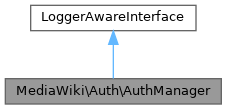
Inherits LoggerAwareInterface.
Public Member Functions | |
| __construct (WebRequest $request, Config $config, ObjectFactory $objectFactory, HookContainer $hookContainer, ReadOnlyMode $readOnlyMode, UserNameUtils $userNameUtils, BlockManager $blockManager, WatchlistManager $watchlistManager, ILoadBalancer $loadBalancer, Language $contentLanguage, LanguageConverterFactory $languageConverterFactory, BotPasswordStore $botPasswordStore, UserFactory $userFactory, UserIdentityLookup $userIdentityLookup, UserOptionsManager $userOptionsManager) | |
| forcePrimaryAuthenticationProviders (array $providers, $why) | |
| Force certain PrimaryAuthenticationProviders. | |
| getRequest () | |
| setLogger (LoggerInterface $logger) | |
Authentication | |
| canAuthenticateNow () | |
| Indicate whether user authentication is possible. | |
| beginAuthentication (array $reqs, $returnToUrl) | |
| Start an authentication flow. | |
| continueAuthentication (array $reqs) | |
| Continue an authentication flow. | |
| securitySensitiveOperationStatus ( $operation) | |
| Whether security-sensitive operations should proceed. | |
| userCanAuthenticate ( $username) | |
| Determine whether a username can authenticate. | |
| normalizeUsername ( $username) | |
| Provide normalized versions of the username for security checks. | |
| setRequestContextUserFromSessionUser () | |
| Call this method to set the request context user for the current request from the context session user. | |
Authentication data changing | |
| revokeAccessForUser ( $username) | |
| Revoke any authentication credentials for a user. | |
| allowsAuthenticationDataChange (AuthenticationRequest $req, $checkData=true) | |
| Validate a change of authentication data (e.g. | |
| changeAuthenticationData (AuthenticationRequest $req, $isAddition=false) | |
| Change authentication data (e.g. | |
Account linking | |
| canLinkAccounts () | |
| Determine whether accounts can be linked. | |
| beginAccountLink (User $user, array $reqs, $returnToUrl) | |
| Start an account linking flow. | |
| continueAccountLink (array $reqs) | |
| Continue an account linking flow. | |
Public Attributes | |
| const | ACCOUNT_CREATION_STATE = 'AuthManager::accountCreationState' |
| const | ACCOUNT_LINK_STATE = 'AuthManager::accountLinkState' |
| const | ACTION_CHANGE = 'change' |
| Change a user's credentials. | |
| const | ACTION_CREATE = 'create' |
| Create a new user. | |
| const | ACTION_CREATE_CONTINUE = 'create-continue' |
| Continue a user creation process that was interrupted by the need for user input or communication with an external provider. | |
| const | ACTION_LINK = 'link' |
| Link an existing user to a third-party account. | |
| const | ACTION_LINK_CONTINUE = 'link-continue' |
| Continue a user linking process that was interrupted by the need for user input or communication with an external provider. | |
| const | ACTION_LOGIN = 'login' |
| Log in with an existing (not necessarily local) user. | |
| const | ACTION_LOGIN_CONTINUE = 'login-continue' |
| Continue a login process that was interrupted by the need for user input or communication with an external provider. | |
| const | ACTION_REMOVE = 'remove' |
| Remove a user's credentials. | |
| const | ACTION_UNLINK = 'unlink' |
| Like ACTION_REMOVE but for linking providers only. | |
| const | AUTHN_STATE = 'AuthManager::authnState' |
| const | AUTOCREATE_BLOCKLIST = 'AuthManager::AutoCreateBlacklist' |
| const | AUTOCREATE_SOURCE_MAINT = '::Maintenance::' |
| Auto-creation is due to a Maintenance script. | |
| const | AUTOCREATE_SOURCE_SESSION = \MediaWiki\Session\SessionManager::class |
| Auto-creation is due to SessionManager. | |
| const | AUTOCREATE_SOURCE_TEMP = TempUserCreator::class |
| Auto-creation is due to temporary account creation on page save. | |
| const | SEC_FAIL = 'fail' |
| Security-sensitive should not be performed. | |
| const | SEC_OK = 'ok' |
| Security-sensitive operations are ok. | |
| const | SEC_REAUTH = 'reauth' |
| Security-sensitive operations should re-authenticate. | |
Account creation | |
| canCreateAccounts () | |
| Determine whether accounts can be created. | |
| canCreateAccount ( $username, $options=[]) | |
| Determine whether a particular account can be created. | |
| probablyCanCreateAccount (Authority $creator) | |
| Check whether $creator can create accounts. | |
| authorizeCreateAccount (Authority $creator) | |
| Authorize the account creation by $creator. | |
| beginAccountCreation (Authority $creator, array $reqs, $returnToUrl) | |
| Start an account creation flow. | |
| continueAccountCreation (array $reqs) | |
| Continue an account creation flow. | |
| autoCreateUser (User $user, $source, $login=true, $log=true, ?Authority $performer=null) | |
| Auto-create an account, and optionally log into that account. | |
Information methods | |
| getAuthenticationRequests ( $action, ?UserIdentity $user=null) | |
| Return the applicable list of AuthenticationRequests. | |
| userExists ( $username, $flags=IDBAccessObject::READ_NORMAL) | |
| Determine whether a username exists. | |
| allowsPropertyChange ( $property) | |
| Determine whether a user property should be allowed to be changed. | |
| getAuthenticationProvider ( $id) | |
| Get a provider by ID. | |
Internal methods | |
| setAuthenticationSessionData ( $key, $data) | |
| Store authentication in the current session. | |
| getAuthenticationSessionData ( $key, $default=null) | |
| Fetch authentication data from the current session. | |
| removeAuthenticationSessionData ( $key) | |
| Remove authentication data. | |
| providerArrayFromSpecs ( $class, array $specs) | |
| Create an array of AuthenticationProviders from an array of ObjectFactory specs. | |
| getPreAuthenticationProviders () | |
| Get the list of PreAuthenticationProviders. | |
| getPrimaryAuthenticationProviders () | |
| Get the list of PrimaryAuthenticationProviders. | |
| getSecondaryAuthenticationProviders () | |
| Get the list of SecondaryAuthenticationProviders. | |
Detailed Description
This serves as the entry point to the authentication system.
In the future, it may also serve as the entry point to the authorization system.
If you are looking at this because you are working on an extension that creates its own login or signup page, then 1) you really shouldn't do that, 2) if you feel you absolutely have to, subclass AuthManagerSpecialPage or build it on the client side using the clientlogin or the createaccount API. Trying to call this class directly will very likely end up in security vulnerabilities or broken UX in edge cases.
If you are working on an extension that needs to integrate with the authentication system (e.g. by providing a new login method, or doing extra permission checks), you'll probably need to write an AuthenticationProvider.
If you want to create a "reserved" user programmatically, User::newSystemUser() might be what you are looking for. If you want to change user data, use User::changeAuthenticationData(). Code that is related to some SessionProvider or PrimaryAuthenticationProvider can create a (non-reserved) user by calling AuthManager::autoCreateUser(); it is then the provider's responsibility to ensure that the user can authenticate somehow (see especially PrimaryAuthenticationProvider::autoCreatedAccount()). The same functionality can also be used from Maintenance scripts such as createAndPromote.php. If you are writing code that is not associated with such a provider and needs to create accounts programmatically for real users, you should rethink your architecture. There is no good way to do that as such code has no knowledge of what authentication methods are enabled on the wiki and cannot provide any means for users to access the accounts it would create.
The two main control flows when using this class are as follows:
- Login, user creation or account linking code will call getAuthenticationRequests(), populate the requests with data (by using them to build a HTMLForm and have the user fill it, or by exposing a form specification via the API, so that the client can build it), and pass them to the appropriate begin* method. That will return either a success/failure response, or more requests to fill (either by building a form or by redirecting the user to some external provider which will send the data back), in which case they need to be submitted to the appropriate continue* method and that step has to be repeated until the response is a success or failure response. AuthManager will use the session to maintain internal state during the process.
- Code doing an authentication data change will call getAuthenticationRequests(), select a single request, populate it, and pass it to allowsAuthenticationDataChange() and then changeAuthenticationData(). If the data change is user-initiated, the whole process needs to be preceded by a call to securitySensitiveOperationStatus() and aborted if that returns a non-OK status.
- Since
- 1.27
Definition at line 117 of file AuthManager.php.
Constructor & Destructor Documentation
◆ __construct()
| MediaWiki\Auth\AuthManager::__construct | ( | WebRequest | $request, |
| Config | $config, | ||
| ObjectFactory | $objectFactory, | ||
| HookContainer | $hookContainer, | ||
| ReadOnlyMode | $readOnlyMode, | ||
| UserNameUtils | $userNameUtils, | ||
| BlockManager | $blockManager, | ||
| WatchlistManager | $watchlistManager, | ||
| ILoadBalancer | $loadBalancer, | ||
| Language | $contentLanguage, | ||
| LanguageConverterFactory | $languageConverterFactory, | ||
| BotPasswordStore | $botPasswordStore, | ||
| UserFactory | $userFactory, | ||
| UserIdentityLookup | $userIdentityLookup, | ||
| UserOptionsManager | $userOptionsManager ) |
Definition at line 235 of file AuthManager.php.
References MediaWiki\Auth\AuthManager\setLogger().
Member Function Documentation
◆ allowsAuthenticationDataChange()
| MediaWiki\Auth\AuthManager::allowsAuthenticationDataChange | ( | AuthenticationRequest | $req, |
| $checkData = true ) |
Validate a change of authentication data (e.g.
passwords)
- Parameters
-
AuthenticationRequest $req bool $checkData If false, $req hasn't been loaded from the submission so checks on user-submitted fields should be skipped. $req->username is considered user-submitted for this purpose, even if it cannot be changed via $req->loadFromSubmission.
- Returns
- Status
Definition at line 1066 of file AuthManager.php.
◆ allowsPropertyChange()
| MediaWiki\Auth\AuthManager::allowsPropertyChange | ( | $property | ) |
Determine whether a user property should be allowed to be changed.
Supported properties are:
- emailaddress
- realname
- nickname
- Parameters
-
string $property
- Returns
- bool
Definition at line 2620 of file AuthManager.php.
◆ authorizeCreateAccount()
| MediaWiki\Auth\AuthManager::authorizeCreateAccount | ( | Authority | $creator | ) |
Authorize the account creation by $creator.
- Note
- this method should be used right before the account is created. To check whether a current performer has the potential to create accounts, use
self::probablyCanCreateAccountinstead.
- Since
- 1.39
- Parameters
-
Authority $creator
- Returns
- StatusValue
Definition at line 1263 of file AuthManager.php.
References MediaWiki\Permissions\Authority\authorizeWrite().
◆ autoCreateUser()
| MediaWiki\Auth\AuthManager::autoCreateUser | ( | User | $user, |
| $source, | |||
| $login = true, | |||
| $log = true, | |||
| ?Authority | $performer = null ) |
Auto-create an account, and optionally log into that account.
PrimaryAuthenticationProviders can invoke this method by returning a PASS from beginPrimaryAuthentication/continuePrimaryAuthentication with the username of a non-existing user. SessionProviders can invoke it by returning a SessionInfo with the username of a non-existing user from provideSessionInfo(). Calling this method explicitly (e.g. from a maintenance script) is also fine.
- Parameters
-
User $user User to auto-create string $source What caused the auto-creation? This must be one of: - the ID of a PrimaryAuthenticationProvider,
- one of the self::AUTOCREATE_SOURCE_* constants
bool $login Whether to also log the user in bool $log Whether to generate a user creation log entry (since 1.36) Authority | null $performer The performer of the action to use for user rights checking. Normally null to indicate an anonymous performer. Added in 1.42 for Special:CreateLocalAccount (T234371).
- Returns
- Status Good if user was created, Ok if user already existed, otherwise Fatal
Definition at line 1875 of file AuthManager.php.
References $source, MediaWiki\User\User\addToDatabase(), StatusValue\error(), MediaWiki\User\User\getId(), MediaWiki\User\User\getName(), MediaWiki\User\User\getUserPage(), MediaWiki\Status\Status\getWikiText(), StatusValue\isGood(), StatusValue\isOK(), MediaWiki\User\User\loadFromId(), MediaWiki\User\User\saveSettings(), MediaWiki\User\User\setId(), StatusValue\warning(), and wfMessage().
Referenced by MediaWiki\Auth\AuthManager\continueAuthentication().
◆ beginAccountCreation()
| MediaWiki\Auth\AuthManager::beginAccountCreation | ( | Authority | $creator, |
| array | $reqs, | ||
| $returnToUrl ) |
Start an account creation flow.
In addition to the AuthenticationRequests returned by $this->getAuthenticationRequests(), a client might include a CreateFromLoginAuthenticationRequest from a previous login attempt. If $createFromLoginAuthenticationRequest->hasPrimaryStateForAction( AuthManager::ACTION_CREATE ) returns true, any AuthenticationRequest::PRIMARY_REQUIRED requests should be omitted. If the CreateFromLoginAuthenticationRequest has a username set, that username must be used for all other requests.
- Parameters
-
Authority $creator User doing the account creation AuthenticationRequest[] $reqs string $returnToUrl Url that REDIRECT responses should eventually return to.
- Returns
- AuthenticationResponse
Definition at line 1295 of file AuthManager.php.
References MediaWiki\Permissions\Authority\getUser(), and wfMessage().
◆ beginAccountLink()
| MediaWiki\Auth\AuthManager::beginAccountLink | ( | User | $user, |
| array | $reqs, | ||
| $returnToUrl ) |
Start an account linking flow.
- Parameters
-
User $user User being linked AuthenticationRequest[] $reqs string $returnToUrl Url that REDIRECT responses should eventually return to.
- Returns
- AuthenticationResponse
Definition at line 2191 of file AuthManager.php.
References MediaWiki\User\User\getId(), MediaWiki\User\User\getName(), StatusValue\isGood(), MediaWiki\User\User\isRegistered(), and wfMessage().
◆ beginAuthentication()
| MediaWiki\Auth\AuthManager::beginAuthentication | ( | array | $reqs, |
| $returnToUrl ) |
Start an authentication flow.
In addition to the AuthenticationRequests returned by $this->getAuthenticationRequests(), a client might include a CreateFromLoginAuthenticationRequest from a previous login attempt to preserve state.
Instead of the AuthenticationRequests returned by $this->getAuthenticationRequests(), a client might pass a CreatedAccountAuthenticationRequest from an account creation that just succeeded to log in to the just-created account.
- Parameters
-
AuthenticationRequest[] $reqs string $returnToUrl Url that REDIRECT responses should eventually return to.
- Returns
- AuthenticationResponse See self::continueAuthentication()
Definition at line 366 of file AuthManager.php.
References MediaWiki\Auth\AuthManager\continueAuthentication(), MediaWiki\Auth\AuthManager\getPreAuthenticationProviders(), MediaWiki\Auth\AuthenticationRequest\getRequestByClass(), MediaWiki\Auth\AuthenticationResponse\newFail(), MediaWiki\Auth\AuthenticationResponse\newPass(), and MediaWiki\Auth\AuthManager\removeAuthenticationSessionData().
◆ canAuthenticateNow()
| MediaWiki\Auth\AuthManager::canAuthenticateNow | ( | ) |
Indicate whether user authentication is possible.
It may not be if the session is provided by something like OAuth for which each individual request includes authentication data.
- Returns
- bool
Definition at line 344 of file AuthManager.php.
Referenced by MediaWiki\Auth\AuthManager\securitySensitiveOperationStatus().
◆ canCreateAccount()
| MediaWiki\Auth\AuthManager::canCreateAccount | ( | $username, | |
| $options = [] ) |
Determine whether a particular account can be created.
- Parameters
-
string $username MediaWiki username array $options - flags: (int) Bitfield of IDBAccessObject::READ_* constants, default IDBAccessObject::READ_NORMAL
- creating: (bool) For internal use only. Never specify this.
- Returns
- Status
Definition at line 1153 of file AuthManager.php.
◆ canCreateAccounts()
| MediaWiki\Auth\AuthManager::canCreateAccounts | ( | ) |
Determine whether accounts can be created.
- Returns
- bool
Definition at line 1134 of file AuthManager.php.
References MediaWiki\Auth\PrimaryAuthenticationProvider\TYPE_CREATE, and MediaWiki\Auth\PrimaryAuthenticationProvider\TYPE_LINK.
◆ canLinkAccounts()
| MediaWiki\Auth\AuthManager::canLinkAccounts | ( | ) |
Determine whether accounts can be linked.
- Returns
- bool
Definition at line 2173 of file AuthManager.php.
◆ changeAuthenticationData()
| MediaWiki\Auth\AuthManager::changeAuthenticationData | ( | AuthenticationRequest | $req, |
| $isAddition = false ) |
Change authentication data (e.g.
passwords)
If $req was returned for AuthManager::ACTION_CHANGE, using $req should result in a successful login in the future.
If $req was returned for AuthManager::ACTION_REMOVE, using $req should no longer result in a successful login.
This method should only be called if allowsAuthenticationDataChange( $req, true ) returned success.
- Parameters
-
AuthenticationRequest $req bool $isAddition Set true if this represents an addition of credentials rather than a change. The main difference is that additions should not invalidate BotPasswords. If you're not sure, leave it false.
Definition at line 1107 of file AuthManager.php.
◆ continueAccountCreation()
| MediaWiki\Auth\AuthManager::continueAccountCreation | ( | array | $reqs | ) |
Continue an account creation flow.
- Parameters
-
AuthenticationRequest[] $reqs
- Returns
- AuthenticationResponse
Definition at line 1401 of file AuthManager.php.
References wfMessage().
◆ continueAccountLink()
| MediaWiki\Auth\AuthManager::continueAccountLink | ( | array | $reqs | ) |
Continue an account linking flow.
- Parameters
-
AuthenticationRequest[] $reqs
- Returns
- AuthenticationResponse
Definition at line 2305 of file AuthManager.php.
References wfMessage().
◆ continueAuthentication()
| MediaWiki\Auth\AuthManager::continueAuthentication | ( | array | $reqs | ) |
Continue an authentication flow.
Return values are interpreted as follows:
- status FAIL: Authentication failed. If $response->createRequest is set, that may be passed to self::beginAuthentication() or to self::beginAccountCreation() to preserve state.
- status REDIRECT: The client should be redirected to the contained URL, new AuthenticationRequests should be made (if any), then AuthManager::continueAuthentication() should be called.
- status UI: The client should be presented with a user interface for the fields in the specified AuthenticationRequests, then new AuthenticationRequests should be made, then AuthManager::continueAuthentication() should be called.
- status RESTART: The user logged in successfully with a third-party service, but the third-party credentials aren't attached to any local account. This could be treated as a UI or a FAIL.
- status PASS: Authentication was successful.
- Parameters
-
AuthenticationRequest[] $reqs
- Returns
- AuthenticationResponse
Definition at line 497 of file AuthManager.php.
References MediaWiki\Auth\AuthenticationResponse\ABSTAIN, MediaWiki\Auth\RememberMeAuthenticationRequest\ALWAYS_REMEMBER, MediaWiki\Auth\AuthManager\autoCreateUser(), MediaWiki\Auth\AuthenticationResponse\FAIL, MediaWiki\Auth\AuthManager\getAuthenticationProvider(), MediaWiki\Auth\AuthManager\getAuthenticationSessionData(), MediaWiki\Auth\AuthManager\getPrimaryAuthenticationProviders(), MediaWiki\Auth\AuthenticationRequest\getRequestByClass(), MediaWiki\Auth\AuthManager\getSecondaryAuthenticationProviders(), MediaWiki\Auth\RememberMeAuthenticationRequest\NEVER_REMEMBER, MediaWiki\Auth\AuthenticationResponse\newFail(), MediaWiki\Auth\AuthenticationResponse\newPass(), MediaWiki\Auth\AuthenticationResponse\newRestart(), MediaWiki\Auth\AuthenticationResponse\PASS, MediaWiki\Auth\AuthenticationResponse\REDIRECT, MediaWiki\MainConfigNames\RememberMe, MediaWiki\Auth\AuthManager\removeAuthenticationSessionData(), MediaWiki\Auth\PrimaryAuthenticationProvider\TYPE_LINK, MediaWiki\Auth\AuthenticationResponse\UI, and wfMessage().
Referenced by MediaWiki\Auth\AuthManager\beginAuthentication().
◆ forcePrimaryAuthenticationProviders()
| MediaWiki\Auth\AuthManager::forcePrimaryAuthenticationProviders | ( | array | $providers, |
| $why ) |
Force certain PrimaryAuthenticationProviders.
- Deprecated
- since 1.43; for backwards compatibility only
- Parameters
-
PrimaryAuthenticationProvider[] $providers string $why
Definition at line 289 of file AuthManager.php.
References wfDeprecated().
◆ getAuthenticationProvider()
| MediaWiki\Auth\AuthManager::getAuthenticationProvider | ( | $id | ) |
Get a provider by ID.
- Note
- This is public so extensions can check whether their own provider is installed and so they can read its configuration if necessary. Other uses are not recommended.
- Parameters
-
string $id
- Returns
- AuthenticationProvider|null
Definition at line 2639 of file AuthManager.php.
Referenced by MediaWiki\Auth\AuthManager\continueAuthentication().
◆ getAuthenticationRequests()
| MediaWiki\Auth\AuthManager::getAuthenticationRequests | ( | $action, | |
| ?UserIdentity | $user = null ) |
Return the applicable list of AuthenticationRequests.
Possible values for $action:
- ACTION_LOGIN: Valid for passing to beginAuthentication
- ACTION_LOGIN_CONTINUE: Valid for passing to continueAuthentication in the current state
- ACTION_CREATE: Valid for passing to beginAccountCreation
- ACTION_CREATE_CONTINUE: Valid for passing to continueAccountCreation in the current state
- ACTION_LINK: Valid for passing to beginAccountLink
- ACTION_LINK_CONTINUE: Valid for passing to continueAccountLink in the current state
- ACTION_CHANGE: Valid for passing to changeAuthenticationData to change credentials
- ACTION_REMOVE: Valid for passing to changeAuthenticationData to remove credentials.
- ACTION_UNLINK: Same as ACTION_REMOVE, but limited to linked accounts.
- Parameters
-
string $action One of the AuthManager::ACTION_* constants UserIdentity | null $user User being acted on, instead of the current user.
- Returns
- AuthenticationRequest[]
Definition at line 2442 of file AuthManager.php.
◆ getAuthenticationSessionData()
| MediaWiki\Auth\AuthManager::getAuthenticationSessionData | ( | $key, | |
| $default = null ) |
Fetch authentication data from the current session.
- Note
- For use by AuthenticationProviders only
- Parameters
-
string $key mixed | null $default
- Returns
- mixed
Definition at line 2691 of file AuthManager.php.
Referenced by MediaWiki\Auth\AuthManager\continueAuthentication().
◆ getPreAuthenticationProviders()
|
protected |
Get the list of PreAuthenticationProviders.
- Returns
- PreAuthenticationProvider[]
Definition at line 2759 of file AuthManager.php.
Referenced by MediaWiki\Auth\AuthManager\beginAuthentication().
◆ getPrimaryAuthenticationProviders()
|
protected |
Get the list of PrimaryAuthenticationProviders.
- Returns
- PrimaryAuthenticationProvider[]
Definition at line 2770 of file AuthManager.php.
Referenced by MediaWiki\Auth\AuthManager\continueAuthentication(), MediaWiki\Auth\AuthManager\normalizeUsername(), and MediaWiki\Auth\AuthManager\userCanAuthenticate().
◆ getRequest()
| MediaWiki\Auth\AuthManager::getRequest | ( | ) |
- Returns
- WebRequest
Definition at line 278 of file AuthManager.php.
◆ getSecondaryAuthenticationProviders()
|
protected |
Get the list of SecondaryAuthenticationProviders.
- Returns
- SecondaryAuthenticationProvider[]
Definition at line 2781 of file AuthManager.php.
Referenced by MediaWiki\Auth\AuthManager\continueAuthentication().
◆ normalizeUsername()
| MediaWiki\Auth\AuthManager::normalizeUsername | ( | $username | ) |
Provide normalized versions of the username for security checks.
Since different providers can normalize the input in different ways, this returns an array of all the different ways the name might be normalized for authentication.
The returned strings should not be revealed to the user, as that might leak private information (e.g. an email address might be normalized to a username).
- Parameters
-
string $username
- Returns
- string[]
Definition at line 995 of file AuthManager.php.
References MediaWiki\Auth\AuthManager\getPrimaryAuthenticationProviders().
◆ probablyCanCreateAccount()
| MediaWiki\Auth\AuthManager::probablyCanCreateAccount | ( | Authority | $creator | ) |
Check whether $creator can create accounts.
- Note
- this method does not guarantee full permissions check, so it should only be used to to decide whether to show a form. To authorize the account creation action use
self::authorizeCreateAccountinstead.
- Since
- 1.39
- Parameters
-
Authority $creator
- Returns
- StatusValue
Definition at line 1239 of file AuthManager.php.
References MediaWiki\Permissions\Authority\probablyCan().
◆ providerArrayFromSpecs()
|
protected |
Create an array of AuthenticationProviders from an array of ObjectFactory specs.
- Parameters
-
string $class array[] $specs
- Returns
- AuthenticationProvider[]
Definition at line 2724 of file AuthManager.php.
◆ removeAuthenticationSessionData()
| MediaWiki\Auth\AuthManager::removeAuthenticationSessionData | ( | $key | ) |
Remove authentication data.
- Note
- For use by AuthenticationProviders
- Parameters
-
string | null $key If null, all data is removed
Definition at line 2705 of file AuthManager.php.
Referenced by MediaWiki\Auth\AuthManager\beginAuthentication(), and MediaWiki\Auth\AuthManager\continueAuthentication().
◆ revokeAccessForUser()
| MediaWiki\Auth\AuthManager::revokeAccessForUser | ( | $username | ) |
Revoke any authentication credentials for a user.
After this, the user should no longer be able to log in.
- Parameters
-
string $username
Definition at line 1048 of file AuthManager.php.
◆ securitySensitiveOperationStatus()
| MediaWiki\Auth\AuthManager::securitySensitiveOperationStatus | ( | $operation | ) |
Whether security-sensitive operations should proceed.
A "security-sensitive operation" is something like a password or email change, that would normally have a "reenter your password to confirm" box if we only supported password-based authentication.
- Parameters
-
string $operation Operation being checked. This should be a message-key-like string such as 'change-password' or 'change-email'.
- Returns
- string One of the SEC_* constants.
Definition at line 894 of file AuthManager.php.
References MediaWiki\MainConfigNames\AllowSecuritySensitiveOperationIfCannotReauthenticate, MediaWiki\Auth\AuthManager\canAuthenticateNow(), MediaWiki\MainConfigNames\ReauthenticateTime, MediaWiki\Auth\AuthManager\SEC_FAIL, MediaWiki\Auth\AuthManager\SEC_OK, and MediaWiki\Auth\AuthManager\SEC_REAUTH.
◆ setAuthenticationSessionData()
| MediaWiki\Auth\AuthManager::setAuthenticationSessionData | ( | $key, | |
| $data ) |
Store authentication in the current session.
- Note
- For use by AuthenticationProviders only
- Parameters
-
string $key mixed $data Must be serializable
Definition at line 2674 of file AuthManager.php.
◆ setLogger()
| MediaWiki\Auth\AuthManager::setLogger | ( | LoggerInterface | $logger | ) |
Definition at line 271 of file AuthManager.php.
Referenced by MediaWiki\Auth\AuthManager\__construct().
◆ setRequestContextUserFromSessionUser()
| MediaWiki\Auth\AuthManager::setRequestContextUserFromSessionUser | ( | ) |
Call this method to set the request context user for the current request from the context session user.
Useful in cases where we need to make sure that a MediaWiki request outputs correct context data for a user who has just been logged-in.
The method will also update the global language variable based on the session's user's context language.
This won't affect objects which already made a copy of the user or the context, so it shouldn't be relied on too heavily, but can help to make the UI more consistent after changing the user. Typically used after a successful AuthManager action that changed the session user (e.g. AuthManager::autoCreateUser() with the login flag set).
Definition at line 1022 of file AuthManager.php.
◆ userCanAuthenticate()
| MediaWiki\Auth\AuthManager::userCanAuthenticate | ( | $username | ) |
Determine whether a username can authenticate.
This is mainly for internal purposes and only takes authentication data into account, not things like blocks that can change without the authentication system being aware.
- Parameters
-
string $username MediaWiki username
- Returns
- bool
Definition at line 972 of file AuthManager.php.
References MediaWiki\Auth\AuthManager\getPrimaryAuthenticationProviders().
◆ userExists()
| MediaWiki\Auth\AuthManager::userExists | ( | $username, | |
| $flags = IDBAccessObject::READ_NORMAL ) |
Determine whether a username exists.
- Parameters
-
string $username int $flags Bitfield of IDBAccessObject::READ_* constants
- Returns
- bool
Definition at line 2599 of file AuthManager.php.
Member Data Documentation
◆ ACCOUNT_CREATION_STATE
| const MediaWiki\Auth\AuthManager::ACCOUNT_CREATION_STATE = 'AuthManager::accountCreationState' |
- Access: internal
- Key in the user's session data for storing account creation state.
Definition at line 128 of file AuthManager.php.
Referenced by MediaWiki\Auth\ConfirmLinkSecondaryAuthenticationProvider\beginSecondaryAccountCreation(), and MediaWiki\Auth\ConfirmLinkSecondaryAuthenticationProvider\continueSecondaryAccountCreation().
◆ ACCOUNT_LINK_STATE
| const MediaWiki\Auth\AuthManager::ACCOUNT_LINK_STATE = 'AuthManager::accountLinkState' |
- Access: internal
- Key in the user's session data for storing account linking state.
Definition at line 134 of file AuthManager.php.
◆ ACTION_CHANGE
| const MediaWiki\Auth\AuthManager::ACTION_CHANGE = 'change' |
Change a user's credentials.
Definition at line 162 of file AuthManager.php.
Referenced by MediaWiki\Auth\ConfirmLinkSecondaryAuthenticationProvider\continueLinkAttempt(), MediaWiki\Auth\AbstractPasswordPrimaryAuthenticationProvider\getAuthenticationRequests(), MediaWiki\Auth\AbstractTemporaryPasswordPrimaryAuthenticationProvider\getAuthenticationRequests(), MediaWiki\Auth\PasswordAuthenticationRequest\getFieldInfo(), and MediaWiki\Auth\ResetPasswordSecondaryAuthenticationProvider\tryReset().
◆ ACTION_CREATE
| const MediaWiki\Auth\AuthManager::ACTION_CREATE = 'create' |
Create a new user.
Definition at line 150 of file AuthManager.php.
Referenced by MediaWiki\Auth\AbstractPasswordPrimaryAuthenticationProvider\getAuthenticationRequests(), MediaWiki\Auth\AbstractTemporaryPasswordPrimaryAuthenticationProvider\getAuthenticationRequests(), MediaWiki\Auth\CreateFromLoginAuthenticationRequest\hasPrimaryStateForAction(), and MediaWiki\Auth\CreateFromLoginAuthenticationRequest\hasStateForAction().
◆ ACTION_CREATE_CONTINUE
| const MediaWiki\Auth\AuthManager::ACTION_CREATE_CONTINUE = 'create-continue' |
Continue a user creation process that was interrupted by the need for user input or communication with an external provider.
Definition at line 154 of file AuthManager.php.
◆ ACTION_LINK
| const MediaWiki\Auth\AuthManager::ACTION_LINK = 'link' |
Link an existing user to a third-party account.
Definition at line 156 of file AuthManager.php.
◆ ACTION_LINK_CONTINUE
| const MediaWiki\Auth\AuthManager::ACTION_LINK_CONTINUE = 'link-continue' |
Continue a user linking process that was interrupted by the need for user input or communication with an external provider.
Definition at line 160 of file AuthManager.php.
◆ ACTION_LOGIN
| const MediaWiki\Auth\AuthManager::ACTION_LOGIN = 'login' |
Log in with an existing (not necessarily local) user.
Definition at line 144 of file AuthManager.php.
Referenced by MediaWiki\Auth\AbstractPasswordPrimaryAuthenticationProvider\getAuthenticationRequests(), MediaWiki\Auth\AbstractTemporaryPasswordPrimaryAuthenticationProvider\getAuthenticationRequests(), MediaWiki\Auth\PasswordAuthenticationRequest\getFieldInfo(), and MediaWiki\Auth\CreateFromLoginAuthenticationRequest\hasStateForAction().
◆ ACTION_LOGIN_CONTINUE
| const MediaWiki\Auth\AuthManager::ACTION_LOGIN_CONTINUE = 'login-continue' |
Continue a login process that was interrupted by the need for user input or communication with an external provider.
Definition at line 148 of file AuthManager.php.
◆ ACTION_REMOVE
| const MediaWiki\Auth\AuthManager::ACTION_REMOVE = 'remove' |
Remove a user's credentials.
Definition at line 164 of file AuthManager.php.
Referenced by MediaWiki\Auth\AbstractPasswordPrimaryAuthenticationProvider\getAuthenticationRequests(), MediaWiki\Auth\AbstractTemporaryPasswordPrimaryAuthenticationProvider\getAuthenticationRequests(), MediaWiki\Auth\PasswordAuthenticationRequest\getFieldInfo(), MediaWiki\Auth\AbstractTemporaryPasswordPrimaryAuthenticationProvider\providerChangeAuthenticationData(), MediaWiki\Auth\AbstractPrimaryAuthenticationProvider\providerRevokeAccessForUser(), and MediaWiki\Auth\AbstractSecondaryAuthenticationProvider\providerRevokeAccessForUser().
◆ ACTION_UNLINK
| const MediaWiki\Auth\AuthManager::ACTION_UNLINK = 'unlink' |
Like ACTION_REMOVE but for linking providers only.
Definition at line 166 of file AuthManager.php.
◆ AUTHN_STATE
| const MediaWiki\Auth\AuthManager::AUTHN_STATE = 'AuthManager::authnState' |
- Access: internal
- Key in the user's session data for storing login state.
Definition at line 122 of file AuthManager.php.
Referenced by MediaWiki\Auth\ConfirmLinkSecondaryAuthenticationProvider\beginSecondaryAuthentication(), and MediaWiki\Auth\ConfirmLinkSecondaryAuthenticationProvider\continueSecondaryAuthentication().
◆ AUTOCREATE_BLOCKLIST
| const MediaWiki\Auth\AuthManager::AUTOCREATE_BLOCKLIST = 'AuthManager::AutoCreateBlacklist' |
- Access: internal
- Key in the user's session data for storing autocreation failures, to avoid re-attempting expensive autocreation checks on every request.
Definition at line 141 of file AuthManager.php.
◆ AUTOCREATE_SOURCE_MAINT
| const MediaWiki\Auth\AuthManager::AUTOCREATE_SOURCE_MAINT = '::Maintenance::' |
Auto-creation is due to a Maintenance script.
Definition at line 179 of file AuthManager.php.
◆ AUTOCREATE_SOURCE_SESSION
| const MediaWiki\Auth\AuthManager::AUTOCREATE_SOURCE_SESSION = \MediaWiki\Session\SessionManager::class |
Auto-creation is due to SessionManager.
Definition at line 176 of file AuthManager.php.
◆ AUTOCREATE_SOURCE_TEMP
| const MediaWiki\Auth\AuthManager::AUTOCREATE_SOURCE_TEMP = TempUserCreator::class |
Auto-creation is due to temporary account creation on page save.
Definition at line 182 of file AuthManager.php.
◆ SEC_FAIL
| const MediaWiki\Auth\AuthManager::SEC_FAIL = 'fail' |
Security-sensitive should not be performed.
Definition at line 173 of file AuthManager.php.
Referenced by MediaWiki\Auth\AuthManager\securitySensitiveOperationStatus().
◆ SEC_OK
| const MediaWiki\Auth\AuthManager::SEC_OK = 'ok' |
Security-sensitive operations are ok.
Definition at line 169 of file AuthManager.php.
Referenced by MediaWiki\Auth\AuthManager\securitySensitiveOperationStatus().
◆ SEC_REAUTH
| const MediaWiki\Auth\AuthManager::SEC_REAUTH = 'reauth' |
Security-sensitive operations should re-authenticate.
Definition at line 171 of file AuthManager.php.
Referenced by MediaWiki\Auth\AuthManager\securitySensitiveOperationStatus().
The documentation for this class was generated from the following file:
- includes/auth/AuthManager.php