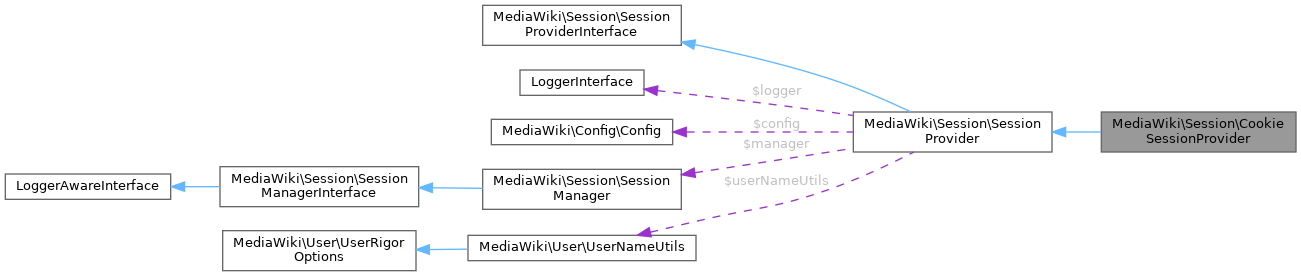
A CookieSessionProvider persists sessions using cookies. More...
Inherits MediaWiki\Session\SessionProvider.
Public Member Functions | |
| __construct ( $params=[]) | |
| canChangeUser () | |
| Indicate whether the user associated with the request can be changed. | |
| getRememberUserDuration () | |
| Returns the duration (in seconds) for which users will be remembered when Session::setRememberUser() is set. | |
| getVaryCookies () | |
| Return the list of cookies that need varying on. | |
| persistSession (SessionBackend $session, WebRequest $request) | |
| Persist a session into a request/response. | |
| persistsSessionId () | |
| Indicate whether self::persistSession() can save arbitrary session IDs. | |
| provideSessionInfo (WebRequest $request) | |
| Provide session info for a request. | |
| suggestLoginUsername (WebRequest $request) | |
| Get a suggested username for the login form. | |
| unpersistSession (WebRequest $request) | |
| Remove any persisted session from a request/response. | |
| whyNoSession () | |
Return a Message for why sessions might not be being persisted.For example, "check whether you're blocking our cookies".
| |
 Public Member Functions inherited from MediaWiki\Session\SessionProvider Public Member Functions inherited from MediaWiki\Session\SessionProvider | |
| __construct () | |
| __toString () | |
| canAlwaysAutocreate () | |
| Returns true if this provider is exempt from autocreate user permissions check. | |
| describe (Language $lang) | |
Return an identifier for this session type.
| |
| getAllowedUserRights (SessionBackend $backend) | |
| Fetch the rights allowed the user when the specified session is active. | |
| getManager () | |
| Get the session manager. | |
| getRestrictions (?array $providerMetadata) | |
| Fetch any restrictions imposed on logins or actions when this session is active. | |
| getVaryHeaders () | |
| Return the HTTP headers that need varying on. | |
| init (LoggerInterface $logger, Config $config, SessionManager $manager, HookContainer $hookContainer, UserNameUtils $userNameUtils) | |
| Initialise with dependencies of a SessionProvider. | |
| invalidateSessionsForUser (User $user) | |
| Invalidate existing sessions for a user. | |
| mergeMetadata (array $savedMetadata, array $providedMetadata) | |
| Merge saved session provider metadata. | |
| newSessionInfo ( $id=null) | |
| Provide session info for a new, empty session. | |
| preventSessionsForUser ( $username) | |
| Prevent future sessions for the user. | |
| refreshSessionInfo (SessionInfo $info, WebRequest $request, &$metadata) | |
| Validate a loaded SessionInfo and refresh provider metadata. | |
| safeAgainstCsrf () | |
| Most session providers require protection against CSRF attacks (usually via CSRF tokens) | |
| sessionIdWasReset (SessionBackend $session, $oldId) | |
| Notification that the session ID was reset. | |
| setConfig (Config $config) | |
| Set configuration. | |
| setHookContainer ( $hookContainer) | |
| setLogger (LoggerInterface $logger) | |
| Sets a logger instance on the object. | |
| setManager (SessionManager $manager) | |
| Set the session manager. | |
Protected Member Functions | |
| cookieDataToExport ( $user, $remember) | |
| Return the data to store in cookies. | |
| getCookie ( $request, $key, $prefix, $default=null) | |
| Get a cookie. | |
| getExtendedLoginCookies () | |
| Gets the list of cookies that must be set to the 'remember me' duration, if $wgExtendedLoginCookieExpiration is in use. | |
| getLoginCookieExpiration ( $cookieName, $shouldRememberUser) | |
| Returns the lifespan of the login cookies, in seconds. | |
| getUserInfoFromCookies ( $request) | |
| Fetch the user identity from cookies. | |
| postInitSetup () | |
| A provider can override this to do any necessary setup after init() is called. | |
| sessionDataToExport ( $user) | |
| Return extra data to store in the session. | |
| setForceHTTPSCookie ( $set, ?SessionBackend $backend, WebRequest $request) | |
| Set the "forceHTTPS" cookie, unless $wgForceHTTPS prevents it. | |
| setLoggedOutCookie ( $loggedOut, WebRequest $request) | |
| Protected Member Functions inherited from MediaWiki\Session\SessionProvider | |
| describeMessage () | |
| Return a Message identifying this session type. | |
| getConfig () | |
| Get the config. | |
| getHookContainer () | |
| Get the HookContainer. | |
| getHookRunner () | |
| Get the HookRunner. | |
| hashToSessionId ( $data, $key=null) | |
| Hash data as a session ID. | |
| makeException ( $key,... $params) | |
| Throw an exception, later. | |
Protected Attributes | |
| mixed[] | $cookieOptions = [] |
| mixed[] | $params = [] |
| Protected Attributes inherited from MediaWiki\Session\SessionProvider | |
| Config | $config |
| LoggerInterface | $logger |
| SessionManager | $manager |
| int | $priority |
| Session priority. | |
| UserNameUtils | $userNameUtils |
Detailed Description
A CookieSessionProvider persists sessions using cookies.
- Since
- 1.27
Definition at line 38 of file CookieSessionProvider.php.
Constructor & Destructor Documentation
◆ __construct()
| MediaWiki\Session\CookieSessionProvider::__construct | ( | $params = [] | ) |
- Parameters
-
array $params Keys include: - priority: (required) Priority of the returned sessions
- sessionName: Session cookie name. Doesn't honor 'prefix'. Defaults to $wgSessionName, or $wgCookiePrefix . '_session' if that is unset.
- cookieOptions: Options to pass to WebRequest::setCookie():
- prefix: Cookie prefix, defaults to $wgCookiePrefix
- path: Cookie path, defaults to $wgCookiePath
- domain: Cookie domain, defaults to $wgCookieDomain
- secure: Cookie secure flag, defaults to $wgCookieSecure
- httpOnly: Cookie httpOnly flag, defaults to $wgCookieHttpOnly
- sameSite: Cookie SameSite attribute, defaults to $wgCookieSameSite
Definition at line 59 of file CookieSessionProvider.php.
References MediaWiki\Session\CookieSessionProvider\$params, MediaWiki\Session\SessionInfo\MAX_PRIORITY, and MediaWiki\Session\SessionInfo\MIN_PRIORITY.
Member Function Documentation
◆ canChangeUser()
| MediaWiki\Session\CookieSessionProvider::canChangeUser | ( | ) |
Indicate whether the user associated with the request can be changed.
If false, any session passed to self::persistSession() will have a user that was originally provided by self::provideSessionInfo(). Further, self::provideSessionInfo() may only provide sessions that have a user already set.
If true, the provider may be passed sessions with arbitrary users, and will be expected to manipulate the request in such a way that future requests will cause self::provideSessionInfo() to provide a SessionInfo with that ID. This can be as simple as not passing any 'userInfo' into SessionInfo's constructor, in which case SessionInfo will load the user from the saved session's metadata.
For example, a session provider for OAuth or SSL client certificates would function by matching the OAuth headers or certificate to a particular user, and thus would return false here since it can't arbitrarily assign those OAuth credentials or that certificate to a different user. A session provider that shoves information into cookies, on the other hand, could easily do so.
- Note
- For use by \MediaWiki\Session\SessionBackend only
- Returns
- bool
Reimplemented from MediaWiki\Session\SessionProvider.
Definition at line 188 of file CookieSessionProvider.php.
◆ cookieDataToExport()
|
protected |
Return the data to store in cookies.
- Parameters
-
User $user bool $remember
- Returns
- array $cookies Set value false to unset the cookie
Definition at line 367 of file CookieSessionProvider.php.
Referenced by MediaWiki\Session\CookieSessionProvider\persistSession().
◆ getCookie()
|
protected |
Get a cookie.
Contains an auth-specific hack.
- Parameters
-
WebRequest $request string $key string $prefix mixed | null $default
- Returns
- mixed
Definition at line 348 of file CookieSessionProvider.php.
Referenced by MediaWiki\Session\CookieSessionProvider\getUserInfoFromCookies(), MediaWiki\Session\CookieSessionProvider\provideSessionInfo(), MediaWiki\Session\CookieSessionProvider\setLoggedOutCookie(), and MediaWiki\Session\CookieSessionProvider\suggestLoginUsername().
◆ getExtendedLoginCookies()
|
protected |
Gets the list of cookies that must be set to the 'remember me' duration, if $wgExtendedLoginCookieExpiration is in use.
- Returns
- string[] Array of unprefixed cookie keys
Definition at line 406 of file CookieSessionProvider.php.
Referenced by MediaWiki\Session\CookieSessionProvider\getLoginCookieExpiration().
◆ getLoginCookieExpiration()
|
protected |
Returns the lifespan of the login cookies, in seconds.
0 means until the end of the session.
Cookies that are session-length do not call this function.
- Parameters
-
string $cookieName bool $shouldRememberUser Whether the user should be remembered long-term
- Returns
- int Cookie expiration time in seconds; 0 for session cookies
Definition at line 420 of file CookieSessionProvider.php.
References MediaWiki\MainConfigNames\CookieExpiration, MediaWiki\MainConfigNames\ExtendedLoginCookieExpiration, MediaWiki\Session\SessionProvider\getConfig(), and MediaWiki\Session\CookieSessionProvider\getExtendedLoginCookies().
Referenced by MediaWiki\Session\CookieSessionProvider\getRememberUserDuration(), MediaWiki\Session\CookieSessionProvider\persistSession(), and MediaWiki\Session\CookieSessionProvider\setForceHTTPSCookie().
◆ getRememberUserDuration()
| MediaWiki\Session\CookieSessionProvider::getRememberUserDuration | ( | ) |
Returns the duration (in seconds) for which users will be remembered when Session::setRememberUser() is set.
Null means setting the remember flag will have no effect (and endpoints should not offer that option).
- Stability: stable
- to override
- Returns
- int|null
Reimplemented from MediaWiki\Session\SessionProvider.
Definition at line 395 of file CookieSessionProvider.php.
References MediaWiki\Session\CookieSessionProvider\getLoginCookieExpiration().
◆ getUserInfoFromCookies()
|
protected |
Fetch the user identity from cookies.
- Parameters
-
WebRequest $request
- Returns
- array (string|null $id, string|null $username, string|null $token)
Definition at line 331 of file CookieSessionProvider.php.
References MediaWiki\Session\CookieSessionProvider\getCookie().
Referenced by MediaWiki\Session\CookieSessionProvider\provideSessionInfo().
◆ getVaryCookies()
| MediaWiki\Session\CookieSessionProvider::getVaryCookies | ( | ) |
Return the list of cookies that need varying on.
- Stability: stable
- to override
- Note
- For use by \MediaWiki\Session\SessionManager only
- Returns
- string[]
Reimplemented from MediaWiki\Session\SessionProvider.
Definition at line 303 of file CookieSessionProvider.php.
◆ persistSession()
| MediaWiki\Session\CookieSessionProvider::persistSession | ( | SessionBackend | $session, |
| WebRequest | $request ) |
Persist a session into a request/response.
For example, you might set cookies for the session's ID, user ID, user name, and user token on the passed request.
To correctly persist a user independently of the session ID, the provider should persist both the user ID (or name, but preferably the ID) and the user token. When reading the data from the request, it should construct a User object from the ID/name and then verify that the User object's token matches the token included in the request. Should the tokens not match, an anonymous user must be passed to SessionInfo::__construct().
When persisting a user independently of the session ID, $session->shouldRememberUser() should be checked first. If this returns false, the user token must not be saved to cookies. The user name and/or ID may be persisted, and should be used to construct an unverified UserInfo to pass to SessionInfo::__construct().
A backend that cannot persist session ID or user info should implement this as a no-op.
- Note
- For use by \MediaWiki\Session\SessionBackend only
- Parameters
-
SessionBackend $session Session to persist WebRequest $request Request into which to persist the session
Reimplemented from MediaWiki\Session\SessionProvider.
Definition at line 192 of file CookieSessionProvider.php.
References MediaWiki\Session\CookieSessionProvider\$cookieOptions, MediaWiki\Session\SessionBackend\addData(), MediaWiki\Session\CookieSessionProvider\cookieDataToExport(), MediaWiki\MainConfigNames\CookieSecure, MediaWiki\MainConfigNames\ForceHTTPS, MediaWiki\Session\SessionProvider\getConfig(), MediaWiki\Session\SessionBackend\getId(), MediaWiki\Session\SessionBackend\getLoggedOutTimestamp(), MediaWiki\Session\CookieSessionProvider\getLoginCookieExpiration(), MediaWiki\Session\SessionBackend\getUser(), MediaWiki\Request\WebRequest\response(), MediaWiki\Session\CookieSessionProvider\sessionDataToExport(), MediaWiki\Session\CookieSessionProvider\setForceHTTPSCookie(), MediaWiki\Session\CookieSessionProvider\setLoggedOutCookie(), MediaWiki\Session\SessionBackend\shouldForceHTTPS(), and MediaWiki\Session\SessionBackend\shouldRememberUser().
◆ persistsSessionId()
| MediaWiki\Session\CookieSessionProvider::persistsSessionId | ( | ) |
Indicate whether self::persistSession() can save arbitrary session IDs.
If false, any session passed to self::persistSession() will have an ID that was originally provided by self::provideSessionInfo().
If true, the provider may be passed sessions with arbitrary session IDs, and will be expected to manipulate the request in such a way that future requests will cause self::provideSessionInfo() to provide a SessionInfo with that ID.
For example, a session provider for OAuth would function by matching the OAuth headers to a particular user, and then would use self::hashToSessionId() to turn the user and OAuth client ID (and maybe also the user token and client secret) into a session ID, and therefore can't easily assign that user+client a different ID. Similarly, a session provider for SSL client certificates would function by matching the certificate to a particular user, and then would use self::hashToSessionId() to turn the user and certificate fingerprint into a session ID, and therefore can't easily assign a different ID either. On the other hand, a provider that saves the session ID into a cookie can easily just set the cookie to a different value.
- Note
- For use by \MediaWiki\Session\SessionBackend only
- Returns
- bool
Reimplemented from MediaWiki\Session\SessionProvider.
Definition at line 184 of file CookieSessionProvider.php.
◆ postInitSetup()
|
protected |
A provider can override this to do any necessary setup after init() is called.
- Since
- 1.37
- Stability: stable
- to override
Reimplemented from MediaWiki\Session\SessionProvider.
Definition at line 88 of file CookieSessionProvider.php.
References MediaWiki\MainConfigNames\CookieDomain, MediaWiki\MainConfigNames\CookieHttpOnly, MediaWiki\MainConfigNames\CookiePath, MediaWiki\MainConfigNames\CookiePrefix, MediaWiki\MainConfigNames\CookieSameSite, MediaWiki\MainConfigNames\CookieSecure, MediaWiki\MainConfigNames\ForceHTTPS, MediaWiki\Session\SessionProvider\getConfig(), and MediaWiki\MainConfigNames\SessionName.
◆ provideSessionInfo()
| MediaWiki\Session\CookieSessionProvider::provideSessionInfo | ( | WebRequest | $request | ) |
Provide session info for a request.
If no session exists for the request, return null. Otherwise return an SessionInfo object identifying the session.
If multiple SessionProviders provide sessions, the one with highest priority wins. In case of a tie, an exception is thrown. SessionProviders are encouraged to make priorities user-configurable unless only max-priority makes sense.
- Warning
- This will be called early in the MediaWiki setup process, before $wgUser, $wgLang, $wgOut, $wgTitle, the global parser, and corresponding pieces of the main RequestContext are set up! If you try to use these, things will break.
- Note
- The SessionProvider must not attempt to auto-create users. MediaWiki will do this later (when it's safe) if the chosen session has a user with a valid name but no ID.
- For use by \MediaWiki\Session\SessionManager only
- Parameters
-
WebRequest $request
- Returns
- SessionInfo|null
Reimplemented from MediaWiki\Session\SessionProvider.
Definition at line 110 of file CookieSessionProvider.php.
References MediaWiki\Session\CookieSessionProvider\getCookie(), MediaWiki\Session\CookieSessionProvider\getUserInfoFromCookies(), MediaWiki\Session\UserInfo\newAnonymous(), MediaWiki\Session\UserInfo\newFromId(), and MediaWiki\Session\SessionManager\validateSessionId().
◆ sessionDataToExport()
|
protected |
Return extra data to store in the session.
- Parameters
-
User $user
- Returns
- array
Definition at line 387 of file CookieSessionProvider.php.
Referenced by MediaWiki\Session\CookieSessionProvider\persistSession().
◆ setForceHTTPSCookie()
|
protected |
Set the "forceHTTPS" cookie, unless $wgForceHTTPS prevents it.
- Parameters
-
bool $set Whether the cookie should be set or not SessionBackend | null $backend WebRequest $request
Definition at line 266 of file CookieSessionProvider.php.
References MediaWiki\MainConfigNames\ForceHTTPS, MediaWiki\Session\SessionProvider\getConfig(), MediaWiki\Session\CookieSessionProvider\getLoginCookieExpiration(), MediaWiki\Request\WebRequest\response(), and MediaWiki\Session\SessionBackend\shouldRememberUser().
Referenced by MediaWiki\Session\CookieSessionProvider\persistSession(), and MediaWiki\Session\CookieSessionProvider\unpersistSession().
◆ setLoggedOutCookie()
|
protected |
- Parameters
-
int $loggedOut timestamp WebRequest $request
Definition at line 294 of file CookieSessionProvider.php.
References MediaWiki\Session\CookieSessionProvider\getCookie(), and MediaWiki\Request\WebRequest\response().
Referenced by MediaWiki\Session\CookieSessionProvider\persistSession().
◆ suggestLoginUsername()
| MediaWiki\Session\CookieSessionProvider::suggestLoginUsername | ( | WebRequest | $request | ) |
Get a suggested username for the login form.
- Stability: stable
- to override
- Note
- For use by \MediaWiki\Session\SessionBackend only
- Parameters
-
WebRequest $request
- Returns
- string|null
Reimplemented from MediaWiki\Session\SessionProvider.
Definition at line 314 of file CookieSessionProvider.php.
References MediaWiki\Session\CookieSessionProvider\getCookie().
◆ unpersistSession()
| MediaWiki\Session\CookieSessionProvider::unpersistSession | ( | WebRequest | $request | ) |
Remove any persisted session from a request/response.
For example, blank and expire any cookies set by self::persistSession().
A backend that cannot persist session ID or user info should implement this as a no-op.
- Note
- For use by \MediaWiki\Session\SessionManager only
- Parameters
-
WebRequest $request Request from which to remove any session data
Reimplemented from MediaWiki\Session\SessionProvider.
Definition at line 235 of file CookieSessionProvider.php.
References MediaWiki\Request\WebRequest\response(), and MediaWiki\Session\CookieSessionProvider\setForceHTTPSCookie().
◆ whyNoSession()
| MediaWiki\Session\CookieSessionProvider::whyNoSession | ( | ) |
Return a Message for why sessions might not be being persisted.For example, "check whether you're blocking our cookies".
- Returns
- Message|null
- Stability: stable
- to override
- Stability: stable
- to override
Reimplemented from MediaWiki\Session\SessionProvider.
Definition at line 391 of file CookieSessionProvider.php.
References wfMessage().
Member Data Documentation
◆ $cookieOptions
|
protected |
Definition at line 44 of file CookieSessionProvider.php.
Referenced by MediaWiki\Session\CookieSessionProvider\persistSession().
◆ $params
|
protected |
Definition at line 41 of file CookieSessionProvider.php.
Referenced by MediaWiki\Session\CookieSessionProvider\__construct().
The documentation for this class was generated from the following file:
- includes/session/CookieSessionProvider.php